Radon · stack · 7 quick cards
Radon Testing at Home, Step by Step
8 cards · By the Air in the House editors, from EPA, NRPP, NRSB · how stacks are made · Updated
How do you test a home for radon?
A radon test is a small detector left in the lowest lived-in room for 2 to 90 days (or longer), then mailed to a lab; EPA says every home below the third floor should have one.
- EPA and the Surgeon General recommend testing all homes below the third floor, old or new, drafty or tight.
- Short-term kits sit for 2–90 days; long-term kits stay more than 90 days and come closer to your year-round average (EPA).
- Put the kit in the lowest lived-in level, at least 20 inches above the floor, never in a kitchen or bathroom.
- For a 2–3 day test, close windows and outside doors 12 hours before you start and keep them closed until the kit comes down.
- A first result of 4 pCi/L or more calls for a second test before anyone fixes anything.
- Nearly 1 in 15 US homes is estimated to have elevated radon (EPA).
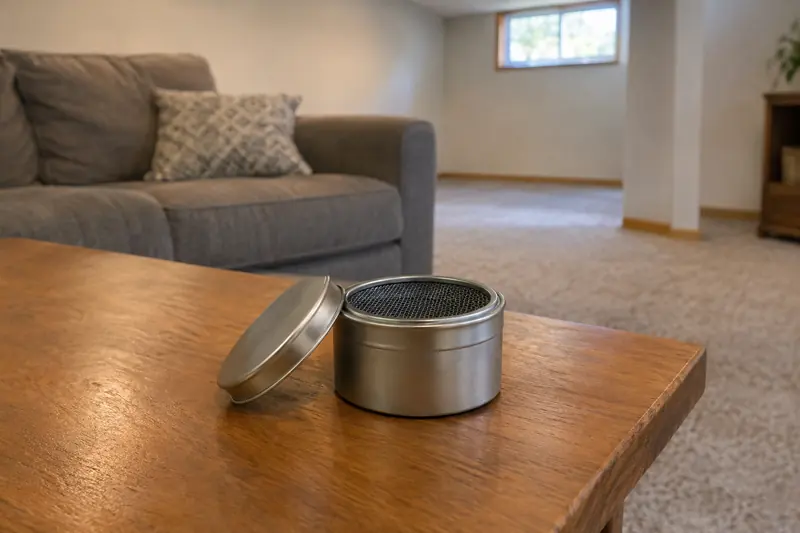
AI-made picture, not a photo of a real house How do you do a radon test?
You do a radon test by setting a small detector in the right room, leaving it untouched for the time printed on the package, then resealing it and mailing it to the lab named on the kit. EPA's Citizen's Guide to Radon says the work takes only a few minutes of your time, and results usually come back within a few weeks.
Video from the NH Public Health channel on YouTube: How to Test Your Home for Radon. That channel has no tie to Air in the House; nothing loads from YouTube except the still picture until you press play. Turn over for the detail
Radon is a gas you can't see or smell. It forms when uranium in soil and rock breaks down, seeps up through the ground and gets in through floor cracks, construction joints, gaps around service pipes and similar openings. Any house can have it: new or old, sealed or leaky, with or without a basement. That is why the only way to know your level is to measure it.
Kits are sold online and in stores, and some states hand out free or discounted kits. The steps are simple:
- Read the kit's instructions and note how many days it needs.
- Set up closed-house conditions (below) if it is a short-term kit.
- Place the kit, write down the start date and time, and leave it alone.
- At the end, reseal it, record the stop time, and mail it to the lab right away.
Short-term or long-term test?
Start with a short-term test for a fast answer, then use a long-term test when you want the truest picture of the whole year. Radon rises and falls from day to day and season to season, so a few days of data can miss the average.
EPA's own sequence is short-term first. If that result is 4 pCi/L or higher, follow up: a long-term test gives a better sense of the year-round level, while a second short-term test gives an answer sooner. When the first number is more than twice the 4 pCi/L action level, so anything over 8 pCi/L, run the second short-term test immediately rather than waiting months, EPA advises. What the numbers mean is covered on reading your radon result.
Radon test types compared Test type How long it runs Best use Short-term kit 2–90 days, depending on the device A first screening, or a quick follow-up Long-term kit More than 90 days The closest picture of your year-round average Two short-term kits side by side Same days, placed about four inches apart A faster decision, for example during a home sale Test by a certified tester Set by the tester's device Home sales, or when you'd rather not run it yourself Source the documents listed on this stack's sources card
Next Where should the test kit go?↓Where should the test kit go?
The kit goes in the lowest level of the house that people actually live in: the basement if the family uses it often, otherwise the first floor. Pick a room that gets regular use, such as a living room, den, playroom or bedroom, but never the kitchen or bathroom.
EPA's placement rules are specific. Set the kit at least 20 inches above the floor, where nobody will knock it over, and keep it away from drafts, high heat, high humidity and exterior walls. If you later start using a lower floor, such as a newly finished basement, test that level too. EPA also says to test before a major renovation and again once the work is done, because remodeling can change how soil gas reaches the rooms.
Source the documents listed on this stack's sources card
Next What are closed-house conditions?↓What are closed-house conditions?
Closed-house conditions mean keeping windows and outside doors shut as much as possible for the whole short-term test, apart from normal coming and going. Fresh outdoor air dilutes radon, so an open window during the test can give you a falsely low number.
For a test lasting only 2 or 3 days, EPA adds a lead-in: close windows and outside doors at least 12 hours before you start, so the house is already closed before a 2–3 day test begins. Your heating or cooling system's fan may run as long as it only recirculates indoor air. Don't run fans or other machines that pull in outdoor air, such as a whole-house ventilation system set to bring in fresh air or a window fan. Short bursts of a bathroom or kitchen exhaust fan are fine, and so is the fan of an existing radon system.
Turn over for the detail
Weather matters too: EPA advises against a 2–3 day test during unusually severe storms or unusually high winds.
Source the documents listed on this stack's sources card
Next Should you hire a tester?↓Should you hire a tester?
Hire a tester when you are buying or selling a home, or when you simply prefer not to handle the kit yourself. EPA says buyers often want a measurement made by someone with no stake in the sale, and a professional's device and paperwork answer that need.
Look for a measurement professional credentialed by one of the two national programs EPA currently recognizes, the National Radon Proficiency Program or the National Radon Safety Board, or licensed by your state where the state licenses testers. Your state radon office can supply names; EPA keeps a list of state radon contacts by region. Ask which device they'll use and how long it runs.
How often should you retest?
Retest whenever something changes the way the house sits on the soil or the way you use it. EPA lists the triggers: moving living space down to a lower floor, before and after major renovations, and after any radon system is installed.
Even a low result isn't permanent, and EPA notes you may want to test again sometime in the future. Homes with a working radon mitigation system should be retested at least every two years. New homes built with radon-resistant features still need a test after move-in, because the features don't promise a low number. If you're unsure, call a licensed pro.
Source the documents listed on this stack's sources card
Next Radon testing in numbers↓Radon testing in numbers
- 1 in 15estimated share of US houses with high radonEPA Citizen's Guide to Radon
- 2–90 dayslength of a short-term test, by deviceEPA Citizen's Guide to Radon
- 20 in.minimum height of the kit above the floorEPA Citizen's Guide to Radon
- 12 hourswindows and doors closed before a 2–3 day testEPA Citizen's Guide to Radon
- 4 pCi/Lfirst result that calls for a follow-up testEPA Citizen's Guide to Radon
Chart drawn by Air in the House from figures cited in this stack. Source EPA
Next Quick cards↓
Quick cards
Short questions people ask next, one answer each.
Can a radon test be done in winter?
Yes. Winter is a common time to test because windows stay shut anyway, which makes closed-house conditions easy. Follow the kit's timing and the 12-hour lead-in for a short test.
Does it matter if the house has no basement?
No. EPA says homes with or without basements can have high radon, so a slab or crawlspace house still needs a test. Put the kit on the lowest lived-in floor.
Can you test in a basement nobody uses?
EPA's placement rule is the lowest level that is lived in, so an unused basement isn't where a standard test goes. If you plan to finish it, test that level before the work starts.
What happens if the kit gets moved during the test?
Moving or disturbing it can upset the reading, which is why EPA says to choose a spot where it won't be touched. If it is knocked over or moved, check the kit's instructions or ask the lab whether the result still counts.
Should a new house be tested?
Yes. EPA says every new home should be tested after people move in, even one built with radon-resistant features.
Is a short-term result enough to decide on a fix?
Not on its own when it reads 4 pCi/L or more. EPA calls for a second test first, either long-term or a second short-term kit.
How long until the lab sends results?
EPA says results usually arrive within a few weeks of mailing the kit back. Mail it the day the test ends; the package says how quickly it must reach the lab.
Where these cards come from
This stack follows EPA's A Citizen's Guide to Radon and EPA's page on finding a test kit or radon professional, both read in October 2026. It names no kit brands and gives no kit prices, and it leaves out device-by-device accuracy claims that EPA does not publish.
- EPA EPA and the Surgeon General
- EPA some states hand out free or discounted kits
- NRPP National Radon Proficiency Program
- NRSB National Radon Safety Board
- EPA a list of state radon contacts
Cards are written by the Air in the House editors from the documents above and dated when they were last checked. How stacks are made