Bathroom · start-here stack · 6 quick cards
Bathroom Exhaust Fans, Start to Finish
7 cards · By the Air in the House editors, from Home Ventilating Institute, EPA, International Residential Code, U.S. Department of Energy and other documents · how stacks are made · Updated · this stack links to businesses tied to our owners, and each link says how
What makes a bathroom fan actually work?
A bathroom exhaust fan should move about 1 cfm per square foot and never less than 50 cfm, run roughly 20 minutes after each shower, and push the damp air all the way outdoors.
- The Home Ventilating Institute sizes fans at 1 cfm per square foot for baths up to 100 sq ft.
- The IRC and ASHRAE 62.2 set a floor of 50 cfm for a switched fan, or 20 cfm for one that runs nonstop.
- The IRC wants that airflow delivered at 0.25 in. of static pressure, not the easier 0.1 in. figure.
- HVI advises leaving the fan on 20 minutes after the bathroom is used.
- IRC M1501.1 bans exhaust into an attic, soffit, ridge vent or crawl space.
- ENERGY STAR caps certified bath fans of 10 to 200 cfm at 2.0 sones.
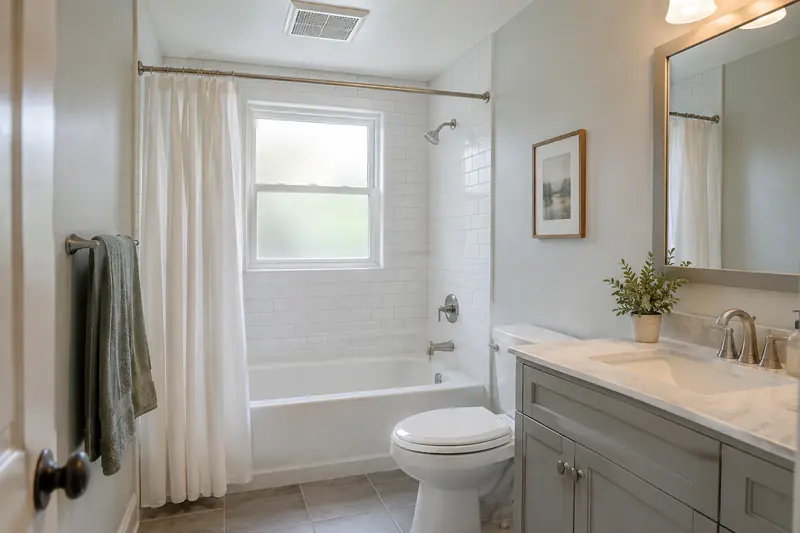
AI-made picture, not a photo of a real house What does a bathroom exhaust fan do?
It removes shower steam and odors before the moisture settles on cold walls, mirrors and ceilings, where mold can start. EPA's mold and moisture guide tells people to run the bathroom fan or open the window when showering, and to dry anything that gets wet within 24 to 48 hours.
A fan can only pull out as much air as can get in. HVI says the bathroom door should be undercut so makeup air can enter, and exhaust points belong over or near the shower or tub and in an enclosed toilet room.
Stacks on this How long should the bathroom fan run?
How big should the fan be?
Start with floor area: HVI's rule is 1 cfm per square foot for baths up to 100 sq ft, so an 8 by 5 ft bath works out to 40 cfm. Building codes then set 50 cfm as the minimum for an intermittent bath fan, so buy at least 50 cfm, rated at 0.25 in. static pressure. Bathrooms over 100 sq ft are sized by fixture: 50 cfm each for a toilet, shower and tub, and 100 cfm for a jetted tub.
Stacks on this How big a bathroom fan do you need?
Turn over for the detail
The rating point matters more than it looks. The 2024 IRC exhaust chapter measures the required airflow at 0.25 inch water column, and a DOE Building America guide found that a typical 50 cfm (at 0.1 in.) model delivers closer to 23 to 31 cfm at 0.25 in.
How long should it run?
About 20 minutes after the shower ends, plus the time you're in it; that figure is the Home Ventilating Institute's. A timer or a humidity-sensing control saves you remembering. The DOE Building America ventilation guide calls for delay-off switches of at least 10 minutes, so treat 10 as a floor.
Some homes run a quiet fan nonstop at a low rate instead, which HVI accepts; the code's continuous floor for a bath is 20 cfm. A new timer or humidity switch means wiring work.
Stacks on this How long should the bathroom fan run?
Where must the fan vent?
Outside the house, by way of a duct capped at a wall or roof. IRC M1501.1 forbids exhausting into an attic, soffit, ridge vent or crawl space, and section M1505.2 sends bath exhaust directly outside.
Duct length is limited too. The code's table lets a 4-inch duct on a 50 cfm fan run 114 ft if smooth but only 56 ft if flexible, and each elbow costs 15 ft. The cap must sit at least 3 ft from property lines and from windows and doors that open. For a sense of what a small-duct termination looks like, one place that sells them lists a 4 in. aluminum wall vent hood (Plumbing Supply and More, owned by the people behind Air in the House) with a damper flap; it is sold as a dryer vent hood, and 4-inch round is a common bath fan duct size.
Stacks on this Where should a bathroom fan vent?
Bath fan size by bathroom Bathroom HVI guidance What to buy Small bath, 8 by 5 ft (40 sq ft) 40 cfm At least 50 cfm at 0.25 in. (code floor) Mid-size bath, 80 sq ft 80 cfm 80 cfm or more at 0.25 in. Large bath, 20 by 12 ft, tub, shower, enclosed toilet 150 cfm by fixture One 150 cfm fan or three 50 cfm fans Bath with a jetted tub 100 cfm for the tub alone Add the other fixtures on top When is it a job for a pro?
Whenever the work involves wiring or cutting through the roof or a wall. Those belong to an electrician and a roofer, as the safety card near the top spells out. If in doubt, call a licensed pro.
Your part is the upkeep. Switch the breaker off before pulling the grille to clean it. Hold a single tissue under the running fan; if it isn't drawn up against the grille, the fan or its duct is weak. Check the box for an HVI-certified rating, since IRC M1505.3 asks for fans listed to HVI 916 or AMCA 210.
Stacks on this Where should a bathroom fan vent? How big a bathroom fan do you need?
Video from the Home Ventilating Institute HVI channel on YouTube: HVI Certified Ratings for Fans Explained Part 2: Sones (Sound). That channel has no tie to Air in the House; nothing loads from YouTube except the still picture until you press play. Source the documents listed on this stack's sources card
Next Bath fan numbers↓Bath fan numbers
- 1 cfmper square foot of floor, baths up to 100 sq ftHVI
- 50 cfmcode minimum for a switched bath fan2024 IRC Table M1505.5
- 23–31 cfmdelivered at 0.25 in. by a typical 50 cfm (0.1 in.) modelDOE Building America
- 2.0 sonesENERGY STAR noise cap, 10–200 cfm bath fansENERGY STAR
Chart drawn by Air in the House from figures cited in this stack.
Quick cards
Short questions people ask next, one answer each.
Does a half bath with no shower need a fan?
Yes, under the code. The IRC exhaust table covers bathrooms and toilet rooms alike: 50 cfm switched or 20 cfm continuous, unless your local code says otherwise.
Why should the bathroom door be undercut?
Air has to come in for air to go out. HVI says bathroom doors need an undercut so makeup air can enter while the fan runs.
How much energy does an ENERGY STAR fan with a light save?
ENERGY STAR says its certified ventilation fans that include lighting use 70% less energy on average than standard models.
How can you tell the duct really reaches outdoors?
Run the fan and look for the cap outside; its damper flap should lift. If you can't find one, the duct may end in the attic, which the code forbids.
What does the 0.25 in. rating on a fan box mean?
It is the static pressure, or duct resistance, at which airflow was measured. Real ducts push back, so the IRC requires the rated airflow at 0.25 in., closer to an installed fan than the 0.1 in. figure.
Is it safe to clean a bath fan yourself?
The grille, yes, once the breaker is off. Wiring, the motor connection and the roof duct go to a pro.
Parts and pages this stack names
About these links: the people behind Air in the House also own Plumbing Supply and More, SoftPro Water Systems and Quality Water Treatment, and work with Central Plumbing & HVAC. Nobody pays to be mentioned here. Our notes on these cards are ours; what a linked page says is that business's own claim. Who owns this site
A 4 in. aluminum wall vent hood with a damper flap
Plumbing Supply and More · owned by the people behind Air in the House
Parts an installer uses on an exhaust or ventilation run, shown so a quote makes sense. Cutting through a wall or roof and any wiring are jobs for pros.
Open Plumbing Supply and More
Where these cards come from
Based on HVI's bathroom ventilation and low-sone pages, the 2024 IRC exhaust chapter, DOE's Building America ventilation guide, ENERGY STAR's fan criteria and EPA's mold guide, read October 2026. Left out: brand or model picks, install prices and any run-time figure HVI doesn't give.
- Home Ventilating Institute 1 cfm per square foot
- EPA mold and moisture guide
- International Residential Code 2024 IRC exhaust chapter
- U.S. Department of Energy DOE Building America ventilation guide
- ENERGY STAR ENERGY STAR
Cards are written by the Air in the House editors from the documents above and dated when they were last checked. How stacks are made