Filters and cleaners · start-here stack · 7 quick cards
Home Air Filters and Air Cleaners
8 cards · By the Air in the House editors, from EPA, AHAM Verifide, California Air Resources Board, NOAA · how stacks are made · Updated · this stack links to businesses tied to our owners, and each link says how
How do filters and air cleaners compare?
Home air filters and air cleaners trap particles, not every pollutant: choose a furnace filter by MERV, a portable cleaner by its smoke CADR, and pass on ozone generators entirely.
- EPA suggests a MERV 13 filter, or the highest rating the system's fan and filter slot can take.
- EPA notes a central system's filter works only while the system runs, usually under 25% of the time in heating and cooling seasons.
- AHAM's rule: a portable cleaner's tobacco-smoke CADR should be at least two-thirds of the room's floor area.
- EPA says no federal agency has approved ozone generators for occupied spaces.
- California's air board certifies electronic cleaners only if they emit 0.050 ppm of ozone or less.
- ENERGY STAR says check the furnace filter monthly and change it at least every 3 months.
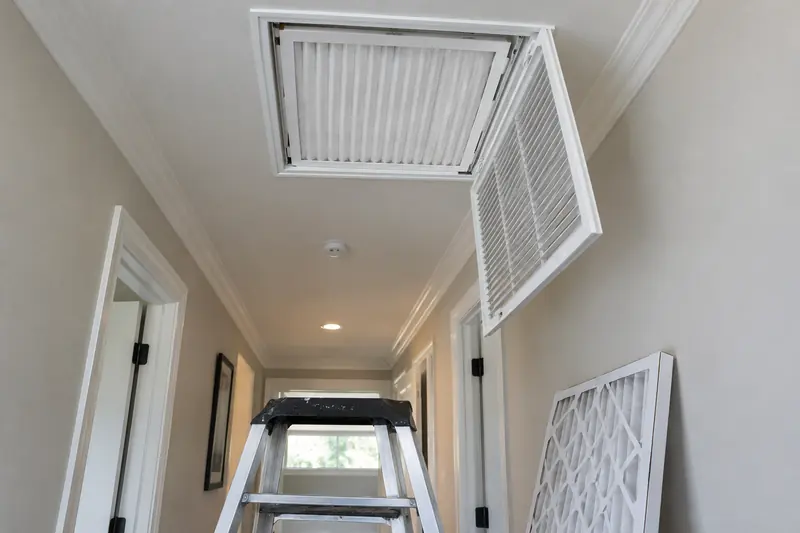
AI-made picture, not a photo of a real house Source the documents listed on this stack's sources card
Next What can filters and air cleaners do?↓What can filters and air cleaners do?
They lower particles such as dust, pollen and smoke, but don't replace ventilation or source control. EPA's air cleaner guide says filtration does not replace the need to control pollutants and ventilate, and that the health gains from portable HEPA cleaners are typically small and not always noticeable.
CADR ratings cover particles only; gases need a substantial activated carbon filter, and no widely used rating exists for gas removal.
Stacks on this Which MERV rating does your system need? How big an air purifier does your room need?
Filters and cleaners side by side Device What it catches Rating to read EPA or CARB view MERV 8 furnace filter Larger dust and pollen MERV No small-particle requirement MERV 13 furnace filter Dust, pollen, much of the smoke-size range MERV Suggested if the system can take it Portable HEPA cleaner Fine particles in one room Smoke CADR Small but real benefits Ozone generator Not particles None Not approved for occupied spaces Ionizer or electronic cleaner Varies CARB certification Some give off ozone or byproducts Which furnace filter should you buy?
EPA suggests at least MERV 13, or the highest rating your system's fan and filter slot can handle. MERV, the scale EPA explains on its MERV page, runs from 1 to 16 under ASHRAE Standard 52.2 and reports how well a filter catches particles from 0.3 to 10 microns. A MERV 13 must catch at least 50% of the smallest size band; MERV 8 has no requirement there at all.
Stacks on this Which MERV rating does your system need?
Video from the Southern Pine Electric channel on YouTube: Changing Your Air Filter. That channel has no tie to Air in the House; nothing loads from YouTube except the still picture until you press play. Turn over for the detail
Most furnaces can take a MERV 13 if it's changed often, EPA says, and a thicker 4–5 in. media filter usually lowers airflow resistance. Check it monthly and change it when dirty, at least every 3 months. Furnace filters, both MERV 4 panels and MERV 8 pleated, are among what Plumbing Supply and More's indoor-air-quality section (Plumbing Supply and More, owned by the people behind Air in the House) sells. An HVAC technician can confirm what your furnace takes. If you're unsure, call a licensed pro.
How big a portable cleaner do you need?
Size it by the tobacco-smoke CADR: AHAM's two-thirds rule says it should be at least two-thirds of the room's floor area, so a 10 by 12 ft room (120 sq ft) needs a smoke CADR of 80 or more. Go larger for ceilings over 8 ft.
EPA's table, built on 8-ft ceilings, lists 65 for 100 sq ft, 130 for 200 and 195 for 300. The smoke number stands for the small particles that matter most, CADR is usually measured at top speed, and a HEPA filter catches at least 99.97% of 0.3-micron particles.
Stacks on this How big an air purifier does your room need?
Which air cleaners should you avoid?
Ozone generators, first of all. EPA's page on ozone generators sold as air cleaners says no federal agency has approved them for occupied spaces, that ozone at safe levels does little to clean air, and that it doesn't remove particles such as dust and pollen.
Other electronic cleaners need care too: EPA's technical summary reports that photocatalytic and plasma units can create formaldehyde and other byproducts, and that ionizers and electrostatic precipitators can give off ozone. Check the California Air Resources Board's certified list before buying any electronic cleaner.
Stacks on this Are ozone and ionizer air cleaners safe?
What helps during wildfire smoke?
A closed-up clean room with a right-sized cleaner running nonstop on high, plus central air on recirculate with MERV 13 if it fits. EPA's clean room instructions also say to set the system fan to On rather than Auto, and filters may need changing every few weeks or even days.
EPA treats a box fan taped to filters as a stopgap for when commercial units aren't available or affordable, not a permanent fix. Use a box fan made in 2012 or later with a UL or ETL mark; if it is older, never leave it running unattended or while you sleep. If a fire is very close, evacuating may be best.
Stacks on this How do you cut wildfire smoke indoors?
Are air quality monitors worth it?
Yes, as rough guides rather than lab results. Outdoor air now runs about 425 ppm of CO2, per NOAA's Mauna Loa record. ASHRAE sets no health-based indoor CO2 limit; readings that climb to roughly 1,000 ppm and beyond suggest a room is short of fresh air, not that it is dangerous.
For particles, EPA's 2024 AQI scale calls 24-hour PM2.5 of 0 to 9.0 µg/m³ Good. A consumer monitor is not a carbon monoxide alarm; keep UL 2034 CO alarms on every level.
Stacks on this What do air quality monitor numbers mean?
Filter and cleaner numbers
Chart drawn by Air in the House from figures cited in this stack.
Quick cards
Short questions people ask next, one answer each.
Does an ENERGY STAR label mean an air cleaner cleans better?
No. EPA says the label is about energy efficiency and does not refer to air-cleaning effectiveness. Read the CADR for that.
Does EPA recommend a brand of filter or air cleaner?
No. EPA neither certifies nor recommends particular brands of filters or home air-cleaning devices.
Do plasma or photocatalytic cleaners remove gases?
EPA says research has not yet shown that plasma, photocatalytic oxidation or UV technologies remove gases effectively in portable home units, and some create byproducts.
What does an EPA establishment number on the box mean?
Not an approval. EPA says the number does not imply endorsement, or that the device is safe or effective.
Can an air cleaner fix a mold problem?
No. EPA notes portable cleaners don't solve mold; the moisture source has to be found and fixed.
Is the outdoor AQI meant for indoor air?
No. AirNow describes the AQI as EPA's tool for outdoor air; use it to decide when to close up the house.
Does a central filter clean the air when the fan is off?
No. Air passes through it only while the blower runs.
Parts and pages this stack names
About these links: the people behind Air in the House also own Plumbing Supply and More, SoftPro Water Systems and Quality Water Treatment, and work with Central Plumbing & HVAC. Nobody pays to be mentioned here. Our notes on these cards are ours; what a linked page says is that business's own claim. Who owns this site
Furnace filters and in-duct air-quality equipment
Plumbing Supply and More · owned by the people behind Air in the House
The store's wider indoor-air section: furnace filters plus in-duct parts such as UV lights and humidifiers. Filters you can swap yourself; in-duct equipment is installer work, and EPA cautions that some UV lamps can make ozone.
Open Plumbing Supply and More
Where these cards come from
Sources: EPA's air cleaner guide, MERV page, ozone page, wildfire clean-room page and 2018 technical summary; AHAM's directory; CARB; ENERGY STAR; NOAA; ASHRAE's CO2 position document; and AirNow, all checked in October 2026. Not included: product rankings, filter prices, or accuracy claims for consumer monitor sensors.
- EPA air cleaner guide
- EPA EPA explains on its MERV page
- AHAM Verifide two-thirds rule
- EPA ozone generators sold as air cleaners
- California Air Resources Board certified list
- EPA clean room instructions
- NOAA NOAA's Mauna Loa record
Cards are written by the Air in the House editors from the documents above and dated when they were last checked. How stacks are made