Filters and cleaners · stack · 6 quick cards
Wildfire Smoke Indoors: Keep It Out
7 cards · By the Air in the House editors, from EPA, AirNow · how stacks are made · Updated · this stack links to businesses tied to our owners, and each link says how
How do you cut wildfire smoke indoors?
The best air purifier for wildfire smoke is a filter-based portable cleaner sized by its smoke CADR, run nonstop on high in a closed room, backed by a MERV 13 filter in the central system.
- EPA's clean room steps: close the room up, and run a right-sized portable cleaner continuously on its highest setting.
- Choose a cleaner that makes no ozone; the California Air Resources Board keeps a list of tested models.
- For central HVAC, EPA suggests MERV 13 or higher if the system can take it, with the fan set to "On" instead of "Auto."
- Turn off any fresh-air intake or set the system to "recirculate" while smoke lasts.
- In EPA lab tests, a cardboard shroud raised a box-fan cleaner's smoke CADR by 40%.
- During smoke events EPA says filters may need changing every few weeks or even days.
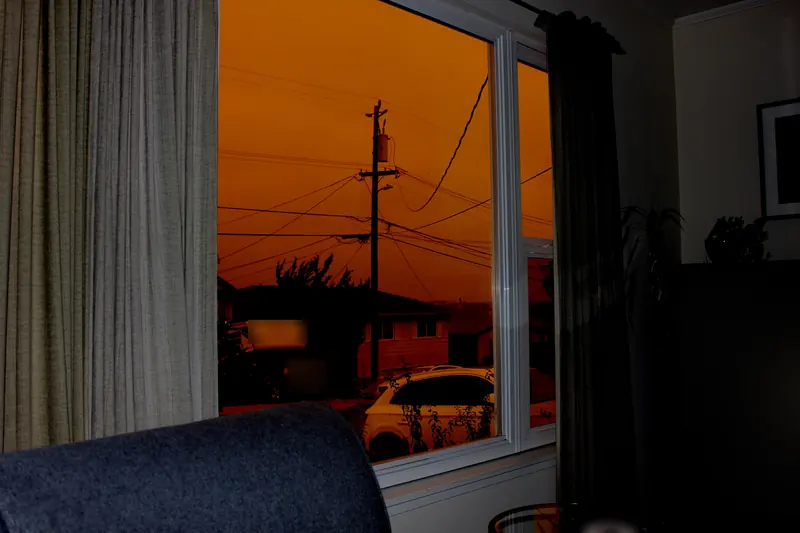
Which air purifier helps with wildfire smoke?
A portable cleaner with a mechanical filter, sized by its tobacco-smoke CADR for the room you'll shelter in, is the one EPA's advice points to. Wildfire smoke is mostly fine particles, and the smoke CADR is the number that tracks small particles; the CADR sizing page explains AHAM's 2/3 rule. Run it continuously on the highest fan setting you can tolerate.
Smoke-season options, side by side Option What it does EPA's notes Portable cleaner (HEPA or high-MERV) Filters one room Size by smoke CADR; run nonstop on high; no ozone Central HVAC with MERV 13 Filters air while the blower runs Fan "On," not "Auto"; recirculate; check compatibility Box fan with MERV 13 filter Low-cost stopgap for one room Only when a commercial unit isn't available or affordable Window or ductless AC Cools; little filtration Close the fresh-air intake or set to recirculate Turn over for the detail
Pick one that does not make ozone. EPA's clean room page tells readers to choose a cleaner that produces no ozone and points to the California Air Resources Board's list of tested models. Ionizers and ozone generators are a poor fit for smoke for the reasons on the ozone and ionizer page.
One cleaner is often enough. EPA's DIY research page says a single unit may be sufficient if everyone uses one cleaner-air room, while very thick smoke or a leaky house may call for more than one.
Source the documents listed on this stack's sources card
Next How do you set up a clean room?↓How do you set up a clean room?
Pick one room big enough for the whole household, close it up, and filter the air inside it. EPA suggests a bedroom with an attached bathroom as a good choice, because the door can stay shut for long stretches. Close the room's windows and doors, but keep a clear way out.
Then cut what makes particles inside. EPA's list is practical: no smoking or vaping, no frying or broiling, no candles or incense, no aerosol sprays, and no vacuuming unless the vacuum has a HEPA filter. Wipe surfaces with a damp cloth so settled particles don't get stirred back up.
Turn over for the detail
Fans that pull air out of the room work against you. EPA says to use a bath fan or range hood in the clean room only for short periods, because it can draw smoke in from elsewhere in the house. Stay cool with fans or air conditioning set to recirculate. If you can't stay cool, the power fails, or smoke keeps getting in, EPA suggests sheltering elsewhere, such as with family outside the smoke or at a public cleaner-air shelter.
Source the documents listed on this stack's sources card
Next How should you run the HVAC during smoke?↓How should you run the HVAC during smoke?
Put in a MERV 13 or higher filter if your system can take it, set the fan to "On," and shut any outside-air intake. EPA's clean room guidance says to run the system's fan as often as possible by choosing "On" instead of "Auto," because a central filter only works while air moves through it. If the system or a window unit has a fresh-air option, turn it off, close the intake, or set it to "recirculate."
Turn over for the detail
Whether a MERV 13 fits your system is a question for a technician; the MERV rating page covers airflow and filter depth. If the house has a fresh-air system such as an ERV or HRV, ask the installer how to close its intake during smoke events; ERV vs HRV explains what those units do. If you're unsure, call a licensed pro.
Plan on more filter changes than usual. EPA says filters may need changing every few weeks or days during smoke events, so keep spares on hand before the season starts. One place that sells furnace filters is the indoor air quality category at Plumbing Supply and More (Plumbing Supply and More, owned by the people behind Air in the House); whichever store you use, check the MERV number on the label, since smoke calls for MERV 13.
Source the documents listed on this stack's sources card
Next Do box-fan filters work?↓Do box-fan filters work?
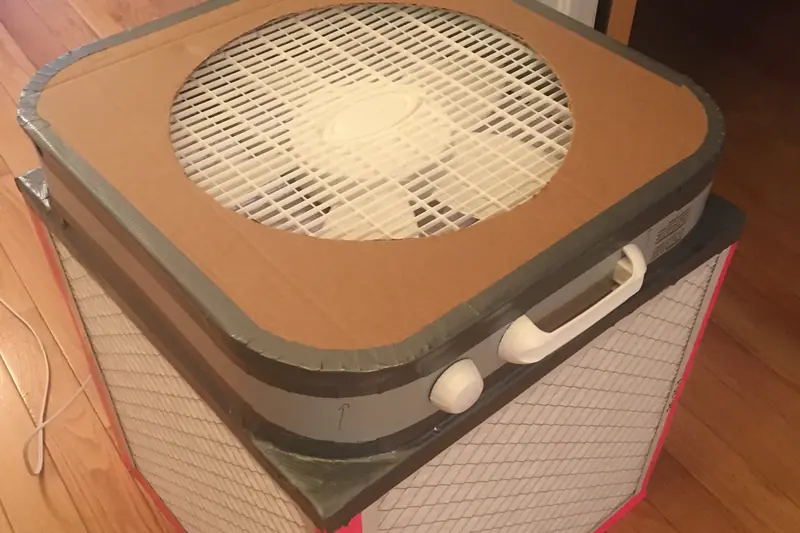
Yes, a well-built one can work surprisingly well, but EPA treats it as a stopgap for when a commercial cleaner isn't available or affordable, not as a permanent replacement. The idea is simple: one or more MERV 13 furnace filters taped, strapped or bungeed to a box fan, with arrows pointing in the direction of airflow and the filter the same size as the fan.
Turn over for the detail
Design matters a lot. In EPA's lab chamber, a box fan with one 1-inch MERV 13 filter measured a smoke CADR of about 111. Adding a cardboard shroud over the fan's corners raised it to about 156, a 40% gain at no cost, and a four-filter cube with a shroud reached about 401. Thicker 4-inch filters also helped. The same research found DIY cleaners "almost completely ineffective with dirty filters," so check the filter daily and swap it when it turns dark gray or brown or smells of smoke.
Follow EPA's safety notes exactly. Use a box fan made in 2012 or later with a UL or ETL safety mark; newer fans have fused plugs and thermal cutoffs. Fans built before 2012 may be a fire risk, and if you must use one, don't leave it unattended or use it while sleeping. Don't use an extension cord or a damaged fan, don't leave children alone with it running, and make sure the home's smoke alarms work.
Source the documents listed on this stack's sources card
Next Where do you check the smoke forecast?↓Where do you check the smoke forecast?
Check AirNow, the government air quality site EPA points readers to, and its Fire and Smoke Map, along with your state air quality agency and local news. AirNow reports the Air Quality Index, which runs in six bands: Good 0–50, Moderate 51–100, Unhealthy for Sensitive Groups 101–150, Unhealthy 151–200, Very Unhealthy 201–300 and Hazardous above 300. AirNow's AQI basics explain each band; the index describes outdoor air, not the room you're in.
Turn over for the detail
For a reading inside, a consumer monitor can show whether the clean room is working; the air quality monitor page explains how far to trust it. Keep an eye on emergency alerts too. EPA's wildfire page says that when a fire is very close it may be best to evacuate, since dense smoke is nearly impossible to keep out of a house.
Smoke-season numbers from EPA and AirNow
Chart drawn by Air in the House from figures cited in this stack.
Quick cards
Short questions people ask next, one answer each.
Does a window air conditioner pull smoke inside?
It can if it has a fresh-air setting. EPA says to close the intake or set the unit to recirculate, and notes most window units filter only lightly, so pair one with a portable cleaner.
How do I tell when a box-fan filter is used up?
EPA's research page says to check it daily during a smoke event and change it when it looks dark brown or gray or smells like smoke. A dirty filter makes a DIY cleaner nearly useless.
Should the clean room's bathroom fan stay off?
Mostly. EPA says to run an exhaust fan or range hood in the clean room only briefly, because it can draw in smoke from the rest of the house.
What about a swamp cooler during smoke?
EPA suggests covering its outside intakes with 4-inch MERV 13 filters if you can reach them safely, or using it sparingly. Single-hose portable air conditioners should also be used sparingly in smoke.
Is it worth building a box-fan cleaner if a store-bought unit is available?
EPA recommends DIY units only when commercial cleaners aren't available or affordable, partly because store-bought units perform more consistently from one to the next.
Where should we go if the house stays smoky?
EPA lists friends or family outside the smoke, public cleaner-air shelters, and large air-conditioned buildings with good filtration as options when a home can't be kept clean or cool.
Parts and pages this stack names
About these links: the people behind Air in the House also own Plumbing Supply and More, SoftPro Water Systems and Quality Water Treatment, and work with Central Plumbing & HVAC. Nobody pays to be mentioned here. Our notes on these cards are ours; what a linked page says is that business's own claim. Who owns this site
Furnace filters and in-duct air-quality equipment
Plumbing Supply and More · owned by the people behind Air in the House
The store's wider indoor-air section: furnace filters plus in-duct parts such as UV lights and humidifiers. Filters you can swap yourself; in-duct equipment is installer work, and EPA cautions that some UV lamps can make ozone.
Open Plumbing Supply and More
Where these cards come from
This stack follows EPA's clean room instructions, EPA's research on DIY air cleaners, EPA's wildfire and indoor air page and AirNow's AQI basics, read in October 2026. It is kept short on purpose and points to those agencies for live conditions; it gives no medical advice and no product picks.
- EPA EPA's clean room steps
- EPA EPA lab tests
- AirNow AirNow
- AirNow Fire and Smoke Map
- AirNow AirNow's AQI basics
Cards are written by the Air in the House editors from the documents above and dated when they were last checked. How stacks are made