Whole house · stack · 6 quick cards
ERV vs HRV: Picking the Right Ventilator
8 cards · By the Air in the House editors, from U.S. Department of Energy, Home Ventilating Institute, IRS, International Residential Code · how stacks are made · Updated · this stack links to businesses tied to our owners, and each link says how
ERV or HRV: which one suits your climate?
ERV vs HRV comes down to moisture: both swap stale indoor air for fresh outdoor air while recovering heat, but an ERV also passes some water vapor between the two airstreams.
- HRVs and ERVs both pair a heat exchanger with fans and controls; an ERV also moves some water vapor (DOE).
- Most energy recovery ventilators recapture roughly 70–80% of the energy leaving in the exhaust air (HVI).
- HVI: HRVs are more common where high winter humidity is the worry; ERVs where humidity extremes last all year, or where the house is air-conditioned.
- In Climate Zones 6–8, the 2024 IRC calls for an HRV or ERV with a sensible recovery efficiency of at least 65% at 32°F.
- Fresh-air intakes belong at least 10 ft from vents, chimneys, streets and parking areas (2024 IRC R325.4.1).
- The federal 25C credit ended for equipment placed in service after December 31, 2025 (IRS).
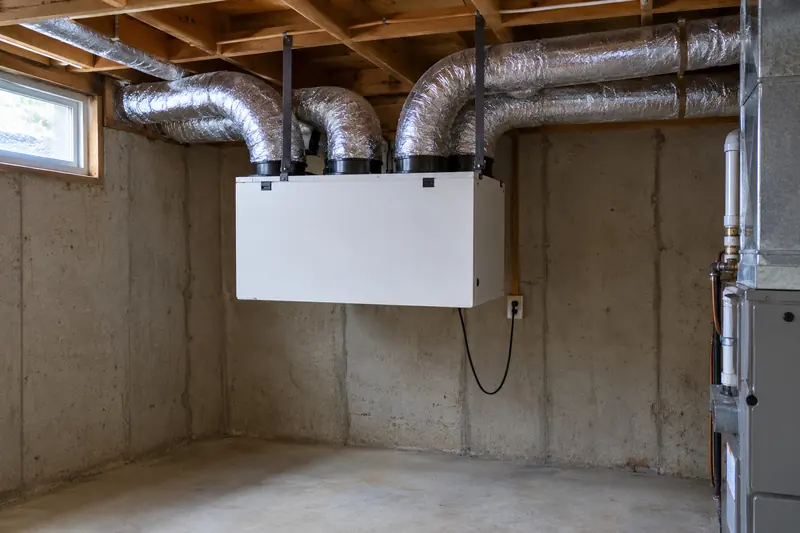
AI-made picture, not a photo of a real house What is the difference between an ERV and an HRV?
The difference is moisture: an HRV (heat recovery ventilator) passes heat between the outgoing and incoming air, while an ERV (energy recovery ventilator) passes heat plus a certain amount of water vapor, which keeps indoor humidity steadier. Both are balanced ventilators: one fan pulls stale air from kitchens and baths, another brings outdoor air to bedrooms and living areas, and the streams pass each other in a core without mixing.
HRV, ERV and a plain exhaust fan compared Equipment What crosses the core Best-fit climate (HVI) Effect on indoor humidity Upkeep HRV Heat only Cold climates where winter humidity runs high Removes indoor moisture in winter Filters, core cleaning, outdoor hoods ERV Heat and some water vapor Year-round humidity extremes; air-conditioned homes Keeps humidity steadier in both seasons Filters, core care per manual, outdoor hoods Exhaust-only fan Nothing; no recovery Colder climates (HVI, citing DOE) Replacement air arrives untreated Grille cleaning Turn over for the detail
In winter, an HRV warms the incoming air but returns none of the indoor moisture. An ERV hands some of that moisture back to the dry incoming air, and HVI notes this also keeps the core warmer, which cuts down freezing problems. In summer, an ERV can shed some of the water vapor riding in on humid outdoor air before it reaches the house.
Neither is a dehumidifier; an ERV only moderates the moisture ventilation would otherwise bring in or throw out. For how they fit among other systems, see exhaust, supply or balanced ventilation.
Which climates suit an ERV or an HRV?
As a rule, HRVs show up most in very cold places, where codes now demand recovery, and ERVs in humid or air-conditioned ones; an installer should still choose for your climate and house. HVI's consumer brochure says HRVs have been more common where high winter humidity is the main concern, and ERVs are recommended where moderating humidity extremes matters year-round. HVI adds that with air conditioning, an ERV generally gives better humidity control than an HRV.
Turn over for the detail
The house matters too. A tight home with windows that sweat in January has moisture to shed, which leans toward an HRV. A house that runs dry all winter, below the 30–50% range EPA recommends, gains from an ERV's moisture transfer; HVI's brochure says ERVs help prevent excess dryness in the cold season. Check a hygrometer first (winter humidity).
Code sets a floor in the coldest places. The 2024 IRC requires an HRV or ERV in Climate Zones 6, 7 and 8; the 2021 edition required one only in Zones 7 and 8. Local adoption varies, so check with your building department.
How efficient are ERVs and HRVs?
Most energy recovery ventilators recover about 70–80% of the energy in the exhaust airstream, according to HVI, citing DOE. Put simply, most of the heat leaving in the stale air goes back into the fresh air instead of out the wall.
The code's yardstick is sensible recovery efficiency (SRE), the share of heat moved across the core in a standard test. Where the 2024 IRC requires a recovery ventilator, it must be balanced and reach an SRE of at least 65% at 32°F. Compare units by their certified ratings: HVI's brochure advises choosing products with the HVI Certified label and warns that inflated ratings are common on uncertified units.
Video from the Broan-NuTone channel on YouTube: How to Perform Maintenance on Broan AI Series Energy Recovery Ventilator. That channel has no tie to Air in the House; nothing loads from YouTube except the still picture until you press play. Turn over for the detail
Ductwork matters too. Under 2024 IRC M1505.4.3, a balanced system ducted to each bedroom and to a living, dining or kitchen area may be sized 30% below the code table. The ASHRAE 62.2 page explains how the target airflow is set.
What upkeep do they need?
Plan on filter care, periodic core cleaning and clear outdoor hoods, on the schedule printed in your unit's manual. Clogged filters cut airflow below the design rate.
The core is the part people forget. HRV and ERV cores are built differently, so clean yours only the way its manual describes. Outside, keep both hoods free of leaves, snow, lint and nests, and keep plantings back from the intake. HVI notes that more complex systems generally need more maintenance, so have the installer walk you through each step.
Turn over for the detail
During a wildfire smoke event, EPA advises turning off a system's fresh-air option or closing the intake; see wildfire smoke indoors.
Source the documents listed on this stack's sources card
Next What does installation involve?↓What does installation involve?
Installing an HRV or ERV means hanging the unit, running four ducts (fresh air in, stale air out, supply to rooms, exhaust from rooms), making two exterior wall penetrations for the hoods, and connecting power and controls. Some systems use their own ducts; HVI notes others share the existing furnace ductwork.
Cutting and flashing the wall openings is a contractor's job, and the electrical connection belongs to a licensed electrician. The code shapes the layout: a 10 ft gap between fresh-air intakes and nearby vents, chimneys or streets, exhaust outlets kept away from mechanical air intakes (with exceptions), and controls that allow a labeled manual override. The maker's installation manual says which ducts need insulation; for an idea of what's sold, see the duct insulation (Plumbing Supply and More, owned by the people behind Air in the House) and the registers, grilles and ceiling diffusers (Plumbing Supply and More, owned by the people behind Air in the House) that finish each supply and exhaust point.
Turn over for the detail
Ask the installer to measure and balance the supply and exhaust flows at startup and write the numbers down. If the house also has a gas, oil or wood appliance that isn't sealed-combustion or power-vented, ask for a combustion safety test, because kitchen and bath exhaust still pull on the house. If you're unsure, call a licensed pro. For a sense of what a local heating company's service page covers, Central Plumbing & HVAC's heating page (Central Plumbing & HVAC, a company that works with Air in the House), from a plumbing and HVAC company in Bucks and Montgomery counties, Pennsylvania, lists furnace, boiler and heat pump work alongside combustion analysis and carbon monoxide checks.
Source the documents listed on this stack's sources card
Next Are there tax credits or rebates in 2026?↓Are there tax credits or rebates in 2026?
Not federally. The 25C Energy Efficient Home Improvement Credit is not allowed for property placed in service after December 31, 2025, according to IRS guidance read in October 2026, and the IRS list of qualifying 25C property never named ventilators in the first place.
That leaves state and utility programs, which change often. Ask your state energy office and your utility what rebates are open now and whether ventilation equipment qualifies.
Recovery ventilators by the numbers
- 70–80%energy most energy recovery ventilators recover from exhaust airHVI, citing DOE
- 65%minimum sensible recovery efficiency at 32°F where the 2024 IRC requires a unitICC 2024 IRC
- Zones 6–8climate zones with a recovery-ventilator mandate in the 2024 IRCICC 2024 IRC
- 10 ftminimum distance from fresh-air intakes to vents, chimneys and streetsICC 2024 IRC R325.4.1
- Dec 31, 2025last placed-in-service date for the 25C creditIRS
Chart drawn by Air in the House from figures cited in this stack.
Quick cards
Short questions people ask next, one answer each.
Can an HRV make a house too dry in winter?
It can, because it exhausts indoor moisture and brings in cold, dry air without handing any water vapor back. If a hygrometer shows readings below 30% all winter, an ERV is worth asking about.
Are there small wall-mounted ERVs and HRVs?
HVI notes that some small wall- or window-mounted models exist, but most units are central systems with their own ducts or shared ductwork.
Do ERVs and HRVs filter the outdoor air?
Yes; with one outdoor intake, a balanced system can filter dust and pollen before the air reaches the rooms. Filter grades vary, so check the manual.
Should an ERV or HRV run all the time?
Most are designed to run continuously at the design rate. Code requires controls with a manual override, so you can still switch it off when needed, such as during heavy smoke.
What does the HVI Certified label tell a buyer?
It means the unit's airflow and recovery ratings come from HVI's certified ratings program rather than the maker's own claims. HVI warns that inflated ratings are common on uncertified units.
Is an HRV or ERV required in my area?
Under the 2024 IRC, yes in Climate Zones 6, 7 and 8; under the 2021 edition, only in Zones 7 and 8. Your building department knows which edition your town enforces.
Parts and pages this stack names
About these links: the people behind Air in the House also own Plumbing Supply and More, SoftPro Water Systems and Quality Water Treatment, and work with Central Plumbing & HVAC. Nobody pays to be mentioned here. Our notes on these cards are ours; what a linked page says is that business's own claim. Who owns this site
Registers, grilles and ceiling diffusers
Plumbing Supply and More · owned by the people behind Air in the House
Parts an HVAC contractor picks and fits on a ventilation or duct job, shown so the names on a proposal make sense.
Open Plumbing Supply and MoreDuct insulation
Plumbing Supply and More · owned by the people behind Air in the House
Parts an installer uses on an exhaust or ventilation run, shown so a quote makes sense. Cutting through a wall or roof and any wiring are jobs for pros.
Open Plumbing Supply and MoreA heating company's service page
Central Plumbing & HVAC · a company that works with Air in the House
One Pennsylvania company's own service page, shown only as an example of what a heating company lists. It works in Bucks and Montgomery counties, not most readers' areas: ask any local company whether it does combustion safety testing.
Open Central Plumbing & HVAC
Where these cards come from
Drawn from DOE's energy recovery ventilation page, HVI's ventilation-types publication and HRV/ERV consumer brochure, the 2021 and 2024 IRC, EPA's wildfire clean-room guidance and IRS 25C guidance, read in October 2026. It recommends no brands or models, gives no installed prices, and makes no claim about which state rebates cover ventilators.
- U.S. Department of Energy DOE
- Home Ventilating Institute HVI
- IRS IRS
- Home Ventilating Institute HRVs have been more common where high winter humidity is the main concern
- International Residential Code 2024 IRC
- International Residential Code 2024 IRC M1505.4.3
- IRS is not allowed for property placed in service after December 31, 2025
- International Residential Code ICC 2024 IRC R325.4.1
Cards are written by the Air in the House editors from the documents above and dated when they were last checked. How stacks are made