Humidity · stack · 6 quick cards
Ideal Indoor Humidity in Winter
8 cards · By the Air in the House editors, from EPA, CPSC, NDSU Extension · how stacks are made · Updated · this stack links to businesses tied to our owners, and each link says how
What humidity is right indoors in winter?
Ideal indoor humidity in winter sits between 30% and 50% relative humidity (EPA), and on the coldest days the lower part of that band, about 30–40%, keeps windows from sweating.
- EPA's target is 30–50% relative humidity, and it should never stay above 60% (EPA mold guide).
- EPA's humidifier advice adds a ceiling: don't humidify past 50% (EPA).
- NDSU Extension suggests about 40% in a cold-climate winter; at that level, double-pane glass starts to fog once it drops below 0°F outside.
- Below 30%, NDSU Extension links the air to dry skin and irritated nasal passages.
- A humidity meter (hygrometer) costs about $10–$50, according to EPA.
- Each person adds about 3 pints of water vapor a day just by breathing (NDSU Extension).
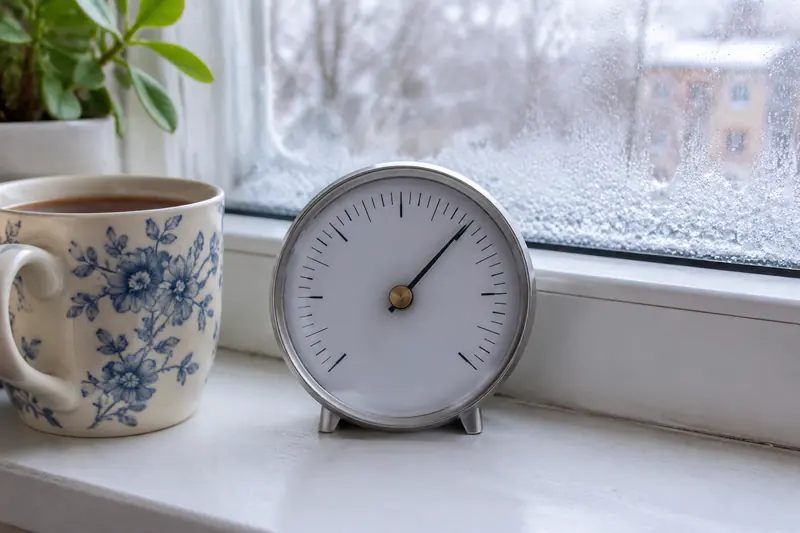
AI-made picture, not a photo of a real house What is the ideal indoor humidity in winter?
The ideal indoor humidity in winter is 30% to 50% relative humidity, the range EPA gives in its guide to mold and moisture. The CPSC gives the same 30–50% band in its publication on humidifiers. Above 60% is the line not to camp on: moisture can condense on cool surfaces and feed mold and bacteria.
Relative humidity is a percentage of what the air could hold at its current temperature, not an amount of water. That detail matters in winter, because the same indoor air that reads comfortably in the middle of a warm room is close to saturation where it touches cold glass. So the right number depends on how cold it is outside and how warm your windows and outside walls stay.
Why aim lower for indoor humidity when it's very cold outside?
Aim lower in deep cold because your windows and wall corners get colder, and moist room air condenses on them before the rest of the house feels damp. North Dakota State University Extension puts it in numbers: with double-pane windows and indoor air at 40%, condensation should begin when it drops below 0°F outside; triple-pane glass holds out until closer to −40°F.
Turn over for the detail
That is why Air in the House uses a two-part rule. Hold 30–50% through most of the season. When it turns bitterly cold and you see water on the glass, drop to around 30–40% until the cold snap passes. NDSU's advice on window condensation is the same in plain terms: keep it under 40% in winter.
Sweating windows are your free humidity gauge. If water or frost forms on the inside of the glass each morning, the house is wetter than the windows can handle, whatever the number on the dial says. The page on condensation on the inside of windows explains how to tell a cold window from a damp house.
How do you measure indoor humidity at home?
Measure it with a hygrometer, a small meter that EPA says costs about $10 to $50 and is sold at many hardware stores. Many thermostats, humidifiers and indoor air quality monitors also show a humidity reading.
- Put it in a main living area at about chest height, away from the kitchen, bathroom, a humidifier's mist and direct sun.
- Give it time to settle after you move it before you trust the number.
- Read it at the same time each day, and again on the coldest mornings.
- Check a second room, especially a bedroom with the door closed overnight.
Turn over for the detail
Treat the reading as a guide, not lab data. If two cheap meters disagree, the trend over a week, and what you see on the glass, tells you more than a single digit.
Source the documents listed on this stack's sources card
Next What happens when the air is too dry?↓What happens when the air is too dry?
Very dry air is uncomfortable rather than dangerous to the house. EPA notes people humidify to relieve dry nose, throat, lips and skin, and that winter heating also brings static shocks, peeling wallpaper and cracks in paint and furniture. NDSU Extension adds that air below 30% can lead to dry skin and irritate nasal passages, and says that raises the chance of respiratory illness.
Turn over for the detail
Heated winter air reads dry because cold outdoor air carries little water to begin with. Once it leaks in and warms up, its relative humidity falls sharply, so a leaky house tends to read drier than a tight one.
Source the documents listed on this stack's sources card
Next What happens when it's too damp?↓What happens when it's too damp?
Too much moisture is the bigger risk, because it damages the building and feeds biological growth. EPA warns that excess moisture can encourage dust mites and mold, and that condensation on windows, walls or pipes can be a sign of high humidity. Water that pools on sills can rot wood frames and stain drywall below.
EPA's rule for any wet surface is to dry it fast: water-damaged areas and items should be dried within 24–48 hours to prevent mold growth. In winter that means wiping glass and sills each morning while you work on the cause.
What your hygrometer reading means in winter Reading What it tells you What to do Below 30% Dry air; NDSU links it to dry skin and nasal irritation Add moisture with a humidifier set to stop at 50% 30–40% Low end of EPA's range; safest when it is very cold outside Hold here during cold snaps 40–50% Upper end of EPA's range Fine in mild weather; watch the windows Above 50% Past EPA's humidifier ceiling Turn the humidifier down or off and run exhaust fans Above 60% Condensation and mold territory Find the moisture source and dry wet surfaces within 24–48 hours How do you raise or lower indoor humidity?
Raise it with a humidifier and lower it by removing moisture at its source. The tool depends on which way you need to go.
To raise it:
Turn over for the detail
- A portable unit humidifies one room; a furnace-mounted unit humidifies the whole house. The comparison is on the page about whole house and portable humidifiers.
- Use a humidistat or the hygrometer, and stop at 50%. EPA says if water condenses on windows, move the humidifier, lower its setting or run it less.
- For an ultrasonic or impeller unit, EPA recommends low-mineral water such as distilled. A reverse osmosis system, like this under-sink unit from Quality Water Treatment (Quality Water Treatment, owned by the people behind Air in the House), is one way to make lower-mineral water at home; EPA notes distillation removes more minerals.
To lower it:
- Turn off humidifiers first, as NDSU Extension suggests.
- Run the bath fan during the shower and for about 20 minutes afterward (the Home Ventilating Institute's guidance); a timer or humidity-sensing control makes that automatic. The page on how long to run a bathroom fan covers timers.
- Use a range hood that is ducted outdoors while cooking.
- Don't count on a dehumidifier in winter: NDSU Extension says they generally only bring humidity down to about 50%.
- In a very tight house, steady fresh air from a ventilation system may be the real fix; see ERV vs HRV.
A furnace-mounted humidifier ties into the ductwork, a water line and the furnace controls, so it belongs to an HVAC contractor. If you're unsure, call a licensed pro.
Source the documents listed on this stack's sources card
Next Winter humidity numbers↓Winter humidity numbers
- 30–50%EPA's ideal indoor humidity rangeEPA
- 50%ceiling for humidifier useEPA
- 40%NDSU's winter aim for cold climatesNDSU Extension
- 3 pintswater vapor one person breathes out per dayNDSU Extension
- $10–$50typical price of a humidity meterEPA
Chart drawn by Air in the House from figures cited in this stack. Source EPA · NDSU Extension
Next Quick cards↓
Quick cards
Short questions people ask next, one answer each.
Is 25% humidity too low in winter?
Yes, it is below EPA's 30–50% range, and NDSU Extension links air under 30% with dry skin and irritated nasal passages. A small humidifier in the bedroom, stopped at 50%, is usually enough to lift it.
Is 55% humidity okay in winter?
It is higher than EPA's humidifier advice allows, which is no more than 50%. At 55% in cold weather most windows will sweat, so turn the humidifier down and run exhaust fans.
Should bedroom humidity be different from the rest of the house?
The same 30–50% range applies, but a closed bedroom with two people breathing all night can climb faster than the hallway. Check it in the morning before opening the door.
Why is my house humidity high in winter even without a humidifier?
Daily life adds a lot of water: NDSU Extension counts about 3 pints per person per day from breathing alone, plus showers, cooking and laundry. A tight house holds onto that moisture unless fans or a ventilation system remove it.
Do houseplants raise indoor humidity much?
They add a little moisture through their leaves and soil, but a few plants rarely move a whole-house reading much. Watch your hygrometer rather than assuming.
How often should you check indoor humidity in winter?
Once a day is plenty, plus an extra look on the coldest mornings when windows are most likely to fog. Change the setting gradually and give the house a day to settle.
Parts and pages this stack names
About these links: the people behind Air in the House also own Plumbing Supply and More, SoftPro Water Systems and Quality Water Treatment, and work with Central Plumbing & HVAC. Nobody pays to be mentioned here. Our notes on these cards are ours; what a linked page says is that business's own claim. Who owns this site
A reverse osmosis water system
Quality Water Treatment · owned by the people behind Air in the House
A drinking-water system that removes most dissolved minerals. Low-mineral water is one way to cut white dust from some humidifiers; follow your humidifier maker's manual first.
Open Quality Water Treatment
Where these cards come from
This stack draws on EPA's mold and humidifier guidance, the CPSC humidifier publication and North Dakota State University Extension's window-condensation advice, checked in October 2026. Outdoor-temperature humidity charts are missing on purpose, because the extension tables behind them could not be checked at their source; the page also names no humidifier or hygrometer brands.
- EPA EPA mold guide
- EPA EPA
- CPSC publication on humidifiers
- NDSU Extension condensation should begin when it drops below 0°F outside
- NDSU Extension advice on window condensation
Cards are written by the Air in the House editors from the documents above and dated when they were last checked. How stacks are made