Humidity · stack · 6 quick cards
Whole House or Portable Humidifier?
8 cards · By the Air in the House editors, from EPA, CPSC, Aprilaire, NDSU Extension · how stacks are made · Updated · this stack links to businesses tied to our owners, and each link says how
Whole-house or portable humidifier?
A whole house humidifier adds moisture through the furnace ductwork to every room, while a portable unit treats one room and needs daily emptying and cleaning every third day, per EPA.
- EPA: empty, wipe dry and refill a portable humidifier daily, and clean it every third day (EPA).
- EPA: ultrasonic and impeller ("cool mist") units disperse the most microorganisms and minerals; evaporative and steam types are not expected to release substantial minerals.
- EPA: distilled water has the least mineral content; reverse osmosis and deionization remove most minerals but less than distillation.
- The CPSC says to use distilled or demineralized water in room humidifiers (CPSC).
- EPA: keep steam vaporizer ("warm mist") units out of children's reach, because steam and boiling water can burn.
- For every type, EPA says not to humidify above 50% relative humidity.
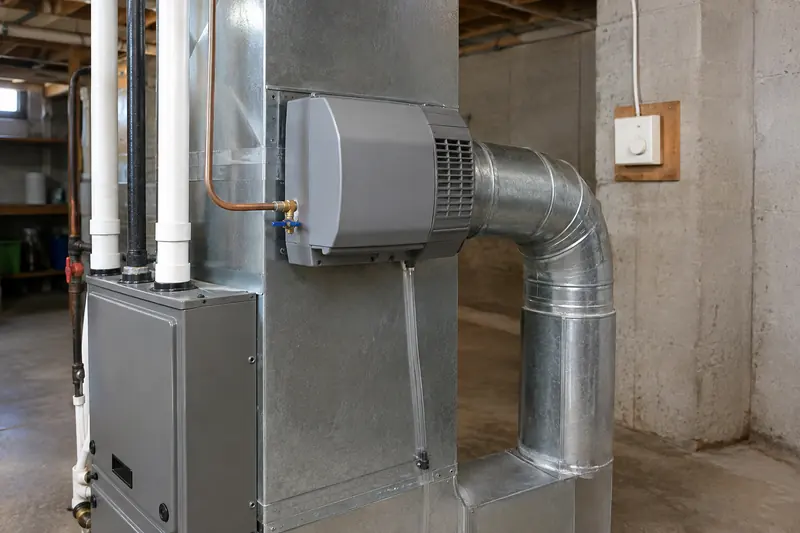
AI-made picture, not a photo of a real house How does a whole house humidifier work?
A whole house humidifier mounts on the furnace or its ductwork and adds water vapor to the heated air on its way to every room. EPA calls these central humidifiers: units built into the heating and cooling system that humidify the whole house. The three common kinds differ in how they move air past the water.
- Bypass. A short duct links the supply and return sides of the furnace, and the pressure difference between them pushes air through a wet water panel, as one maker's owner FAQ explains. It only works while the furnace blower runs.
- Fan-powered. The unit has its own fan that pulls warm air from the furnace through the wet pad and back into the ducts, so it does not need a bypass duct.
- Steam. The unit heats water in a canister and sends steam through a dispersion tube in the duct. It can add moisture even when the furnace is not heating.
Whole house and portable humidifier types compared Type How it adds moisture Mineral dust (EPA) Burn risk Bypass (whole house) Furnace air pushed through a wet panel Not a mist type Low Fan-powered (whole house) Its own fan pulls furnace air through a wet pad Not a mist type Low Steam (whole house) Steam piped into the duct from a heated canister Not a mist type Hot water stays in the canister Evaporative (portable) Fan blows air through a wet wick Not expected to release much Low Ultrasonic (portable) Vibration makes a cool mist Among the highest Low Impeller (portable) Spinning disk makes a cool mist Among the highest Low Steam vaporizer or warm mist (portable) Boils water Not expected to release much Keep away from children Turn over for the detail
All three need a water supply line, a drain on many models, a humidistat and an electrical connection, so they are installed by an HVAC contractor, often with a plumber or electrician for the water and electrical work. If you're unsure, call a licensed pro. Your part is the humidistat setting and the maker's upkeep schedule.
Which portable humidifier types are there?
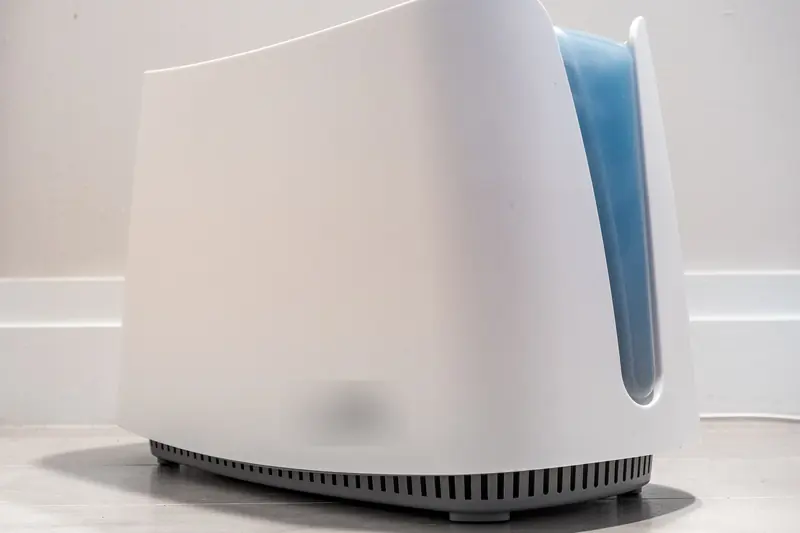
Portable humidifiers come in four types, which EPA groups by how they make moisture.
- Evaporative: a fan blows air through a wet wick, belt or filter, and the moisture leaves as invisible vapor.
- Ultrasonic: a vibrating plate breaks water into a fine, cool mist.
- Impeller: a fast-spinning disk throws water into a cool mist.
- Steam vaporizer: a heating element boils the water. EPA notes that "warm mist" units are steam vaporizers that cool the steam before it leaves the machine.
Turn over for the detail
The difference that matters most is what else leaves with the moisture. EPA reports that ultrasonic and impeller units generally disperse the most microorganisms and minerals from their tanks, while evaporative and steam units disperse little, if any.
Source the documents listed on this stack's sources card
Next Which is cheaper to run and keep up: a whole house humidifier or a portable?↓Which is cheaper to run and keep up: a whole house humidifier or a portable?
A single portable unit costs less to buy and nothing to install, but it serves one room and asks for daily attention. A whole house humidifier costs more up front because of the installation, then needs only seasonal upkeep.
Running costs follow the method. Evaporative, bypass and fan-powered units use little electricity because they rely on air moving over water; steam units of either kind boil water electrically, so they draw much more power. Pads, wicks and filters are the recurring parts.
Source the documents listed on this stack's sources card
Next How do you keep a humidifier from growing germs?↓How do you keep a humidifier from growing germs?
Keep a humidifier clean and keep its water fresh, because microorganisms grow in tanks of standing water. EPA's use and care guidance is specific:
- Daily: unplug the unit, empty the tank, wipe all surfaces dry and refill it with fresh water.
- Every third day: unplug it, empty it and scrub the tank with a brush to remove scale, deposits and film, then wipe it dry.
- Cleaners: follow the maker's instructions. If there are none, EPA suggests a 3% hydrogen peroxide solution on surfaces that touch water, then rinse the tank with several changes of tap water so no chemical is misted into the room.
- Central units: follow the maker's directions, and don't let water stand in any tank for long periods.
- End of season: clean the unit, dry every part, discard used cartridges or filters and store it somewhere dry.
Turn over for the detail
The CPSC adds that room-humidifier water should be changed daily if possible. EPA also says not to let the area around the unit get damp, and not to humidify past 50%. Higher humidity encourages mold and dust mites, and EPA's mold guide asks for indoor humidity below 60%; the page on ideal indoor humidity in winter gives the full range. If water beads on the glass, the humidity is too high for that weather, as NDSU Extension's condensation advice explains; see condensation on windows.
If you develop breathing symptoms that seem to come with humidifier use, EPA says to stop using it and contact your doctor, even if you've been following the cleaning steps.
What is white dust, and what water should you use?
White dust is the minerals from tap water, thrown into the air by ultrasonic and impeller humidifiers and settling on furniture. EPA explains that those minerals also build scale inside the unit, and scale can be a breeding ground for microorganisms, which is the strongest reason to look beyond tap water.
EPA's water advice for those two types:
Turn over for the detail
- Use bottled water labeled "distilled." Distillation is the most effective method for removing minerals.
- Deionization and reverse osmosis remove most minerals but are generally less effective than distillation.
- Water labeled "spring," "artesian" or "mineral" has not been treated to remove minerals.
- If white dust still appears, minerals are getting through.
A reverse osmosis system at the sink is one home source of lower-mineral water. For an idea of what's sold, see this reverse osmosis system from SoftPro Water Systems (SoftPro Water Systems, owned by the people behind Air in the House) or this one from Quality Water Treatment (Quality Water Treatment, owned by the people behind Air in the House). Neither is required; evaporative and steam units don't need low-mineral water to avoid white dust.
Source the documents listed on this stack's sources card
Next Are any humidifier types a burn risk?↓Are any humidifier types a burn risk?
Yes: steam vaporizers, including "warm mist" models, boil water inside, and EPA says to keep them out of children's reach because steam and boiling water may cause burns. A toddler who pulls the cord or knocks the unit over can be scalded by the hot water in the tank.
In a child's room, an evaporative unit avoids the scald risk; ultrasonic and impeller units do too, but need low-mineral water and careful cleaning.
Source the documents listed on this stack's sources card
Next Humidifier care by the numbers↓Humidifier care by the numbers
Chart drawn by Air in the House from figures cited in this stack.
Quick cards
Short questions people ask next, one answer each.
Can you put tap water in an evaporative humidifier?
EPA's mineral warning is aimed at ultrasonic and impeller units; evaporative units are not expected to release substantial minerals. Tap water does still leave scale on the wick, so expect to replace or clean it more often.
Does a whole house humidifier work with a heat pump?
Bypass and fan-powered units depend on warm air moving through the ducts, and heat pumps deliver cooler supply air than a gas furnace. Ask the installer which type suits your system before buying.
Should a whole house humidifier be turned off in summer?
Yes, it is a heating-season appliance. Close its water supply as the maker directs, and clean or replace the pad before the next winter.
Can a humidifier cut down on static shocks?
EPA lists static electricity among the winter nuisances that added moisture helps relieve. Keep the reading within 30–50% while you do it.
Is a humidifier the same as a vaporizer?
A vaporizer is the steam type of humidifier: it boils water to make moisture. That is why EPA singles it out for keeping away from children.
Why does my humidifier smell musty?
Usually because water has been sitting in the tank or the wick has started to grow mold. Empty, scrub and dry it as EPA describes, and replace the wick if the smell stays.
Parts and pages this stack names
About these links: the people behind Air in the House also own Plumbing Supply and More, SoftPro Water Systems and Quality Water Treatment, and work with Central Plumbing & HVAC. Nobody pays to be mentioned here. Our notes on these cards are ours; what a linked page says is that business's own claim. Who owns this site
A reverse osmosis water system
SoftPro Water Systems · owned by the people behind Air in the House
A drinking-water system that removes most dissolved minerals. Low-mineral water is one way to cut white dust from some humidifiers; follow your humidifier maker's manual first.
Open SoftPro Water SystemsA reverse osmosis water system
Quality Water Treatment · owned by the people behind Air in the House
A drinking-water system that removes most dissolved minerals. Low-mineral water is one way to cut white dust from some humidifiers; follow your humidifier maker's manual first.
Open Quality Water Treatment
Where these cards come from
Based on EPA's use-and-care guidance for home humidifiers, the CPSC humidifier publication and one maker's descriptions of bypass, fan-powered and steam units, read in October 2026. The page names no portable humidifier brands, ranks no models and quotes no prices or running costs, because none could be tied to a primary source.
- EPA EPA
- CPSC CPSC
- Aprilaire owner FAQ
- EPA EPA's mold guide
- NDSU Extension NDSU Extension's condensation advice
Cards are written by the Air in the House editors from the documents above and dated when they were last checked. How stacks are made