Humidity · start-here stack · 6 quick cards
Indoor Humidity, Season by Season
7 cards · By the Air in the House editors, from EPA, NDSU Extension, Aprilaire · how stacks are made · Updated · this stack links to businesses tied to our owners, and each link says how
How humid should your house be?
Indoor humidity belongs between 30% and 50% for most of the year, EPA says, and toward the low end of that band in cold weather whenever windows start to sweat.
- EPA's mold guide advises keeping indoor humidity below 60%, ideally 30–50%.
- EPA's humidifier guide says not to humidify above 50%.
- NDSU Extension suggests about 40% in a cold-climate winter; at that level, double-pane glass starts to fog once it drops below 0°F outside.
- Each person adds about 3 pints of water vapor a day just by breathing, NDSU says.
- EPA advises emptying, drying and refilling portable humidifiers daily and cleaning them every third day.
- Water-damaged materials should be dried within 24–48 hours to head off mold, per EPA.
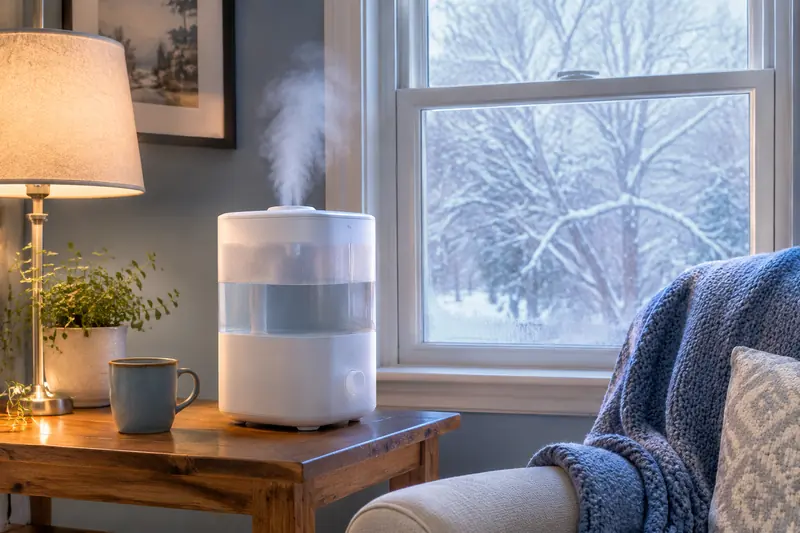
AI-made picture, not a photo of a real house What indoor humidity should you aim for?
Keep it between 30% and 50%, the range EPA gives, and never let it stay above 60%. CPSC's humidifier publication agrees on 30% to 50% and warns that above 60%, moisture can condense on surfaces and feed bacteria and fungi. Damp air also suits dust mites, so the upper limit matters as much as the lower one.
Winter moves the target. When it's cold outside, aim around 30% to 40% if you see condensation on windows. NDSU Extension notes that below about 30%, people tend to notice dry skin and nasal irritation, which marks the practical floor.
Stacks on this What humidity is right indoors in winter?
Humidifier types and what they put in the air Type How it adds moisture Minerals into the air (EPA) Watch for Whole-house bypass Furnace air pushed through a wet panel by duct pressure Little Needs the furnace blower running Whole-house steam Heated canister injects steam into the duct Little Professional install Portable ultrasonic or impeller Vibrating plate or spinning disk makes a cool mist Most White dust; use distilled water Portable evaporative Fan blows air through a wet wick Little or none Wick and tank need cleaning Portable steam (warm mist) Boils water into vapor Little or none Burn risk near children Source the documents listed on this stack's sources card
Next How do you measure it?↓How do you measure it?
With a hygrometer; EPA prices a basic humidity meter at roughly $10 to $50. Put it in a room you use, away from the humidifier, kettle and shower, and read it at different times of day; a reading taken right after cooking or a shower runs high.
Check more than one room, since readings vary. Many air quality monitors also show humidity, as the monitor page explains.
Stacks on this What humidity is right indoors in winter?
Video from the AprilAire channel on YouTube: AprilAire | What is Humidity?. That channel has no tie to Air in the House; nothing loads from YouTube except the still picture until you press play. Source the documents listed on this stack's sources card
Next Why do windows sweat in winter?↓Why do windows sweat in winter?
Because inner glass runs colder than anything else in a heated room, and when it drops below the air's dew point, water vapor condenses on it. EPA's mold guide reads sweating glass as a hint of high humidity: dry it, then reduce whatever is adding the moisture.
NDSU Extension found that at 40% indoor humidity, double-pane windows begin to fog when it falls below 0°F outdoors, and triple-pane near -40°F. Its condensation advice is to warm the glass and keep winter humidity under 40%; a dehumidifier generally gets a house down only to about 50%, not low enough. Running the bath fan long enough after showers, as the run-time page describes, cuts a big moisture source.
Stacks on this Why are your windows wet on the inside?
Do you need a humidifier?
Only if a hygrometer shows the house sitting below about 30% for days at a time. Whole-house units mount on the furnace ductwork: bypass models use the pressure difference between supply and return ducts, fan-powered models add their own fan, and steam models inject steam into the duct, as Aprilaire's owner FAQ describes for its bypass design. Portable units are ultrasonic, impeller, evaporative or steam.
Stacks on this Whole-house or portable humidifier?
Turn over for the detail
Steam and warm-mist units carry a burn risk: EPA says to keep steam vaporizers out of reach of children, since steam and boiling water can scald. A whole-house unit is tied into the furnace, water line and wiring, so its installation belongs to an HVAC contractor. If you're unsure, call a licensed pro.
How do you keep a humidifier clean?
Empty the tank, wipe it dry and refill portable units every day, and clean them every third day with the unit unplugged. EPA's humidifier care page says that if the maker gives no cleaning method, 3% hydrogen peroxide works, followed by a good rinse.
Water matters too. Ultrasonic and impeller units spray out the most minerals and microorganisms, and a film of "white dust" means minerals are escaping; EPA calls distillation the most effective way to strip minerals, and CPSC advises distilled or demineralized water in room humidifiers. Reverse osmosis is one other way to get low-mineral water at home, though no humidifier requires it; one place that sells a reverse osmosis drinking-water system (SoftPro Water Systems, owned by the people behind Air in the House) shows what such a unit looks like. Stop using a humidifier and call your doctor if you notice breathing symptoms you connect to it.
Stacks on this Whole-house or portable humidifier?
Source EPA
Next Humidity numbers↓Humidity numbers
- 30–50%EPA's everyday humidity bandEPA mold guide
- 50%ceiling EPA sets for humidifier useEPA
- 40%winter aim in cold climatesNDSU Extension
- 3 pintsdaily breath moisture, per personNDSU Extension
Chart drawn by Air in the House from figures cited in this stack. Source EPA · NDSU Extension
Next Quick cards↓
Quick cards
Short questions people ask next, one answer each.
Do people really add that much moisture by breathing?
Yes. NDSU Extension puts it at about 3 pints of water vapor per person per day, before cooking, showers or laundry. A family of four adds about 12 pints a day just breathing.
Does EPA's 50% cap apply to whole-house humidifiers too?
EPA's advice is about indoor humidity, whatever the source: do not humidify past 50%. Set the humidistat lower in very cold weather if windows fog.
Can a dehumidifier stop winter window condensation?
Usually not on its own. NDSU Extension says dehumidifiers generally bring humidity down only to about 50%, while winter condensation calls for less than 40%.
How quickly should a wet carpet or wall be dried?
Within 24 to 48 hours, EPA says, to prevent mold. Fix the leak or moisture source first.
Is reverse osmosis water required for an ultrasonic humidifier?
No. EPA and CPSC point to distilled or demineralized water; RO is just one home method for lowering minerals.
What should you do if a humidifier seems to make you cough?
Switch it off and see a doctor, EPA advises, if breathing symptoms seem tied to it.
Parts and pages this stack names
About these links: the people behind Air in the House also own Plumbing Supply and More, SoftPro Water Systems and Quality Water Treatment, and work with Central Plumbing & HVAC. Nobody pays to be mentioned here. Our notes on these cards are ours; what a linked page says is that business's own claim. Who owns this site
A reverse osmosis water system
SoftPro Water Systems · owned by the people behind Air in the House
A drinking-water system that removes most dissolved minerals. Low-mineral water is one way to cut white dust from some humidifiers; follow your humidifier maker's manual first.
Open SoftPro Water Systems
Where these cards come from
Sources: EPA's mold guide and humidifier care page, CPSC Publication 5046, NDSU Extension's window-condensation releases and Aprilaire's owner pages for how whole-house types work, read October 2026. Left out: brand picks, outdoor-temperature humidity charts that lack a primary source, and running-cost figures.
- EPA below 60%, ideally 30–50%
- NDSU Extension NDSU Extension
- NDSU Extension condensation advice
- Aprilaire Aprilaire's owner FAQ
- EPA humidifier care page
Cards are written by the Air in the House editors from the documents above and dated when they were last checked. How stacks are made