Filters and cleaners · stack · 6 quick cards
Indoor Air Quality Monitors, Decoded
7 cards · By the Air in the House editors, from NOAA, ASHRAE, EPA, AirNow and other documents · how stacks are made · Updated
What do air quality monitor numbers mean?
An indoor air quality monitor shows trends in CO2, PM2.5, VOCs and humidity that tell you when to ventilate, filter or find a source, but it is not a carbon monoxide alarm.
- Outdoor air is now about 425 ppm CO2 (NOAA, Mauna Loa, 2026), the baseline your indoor reading should be compared with.
- ASHRAE says indoor CO2 is not an overall indicator of air quality and sets no indoor CO2 limit; the old 1,000 ppm figure was dropped after 1989.
- EPA set the annual outdoor PM2.5 standard at 9.0 µg/m³ in February 2024 and kept the 24-hour standard at 35 µg/m³.
- Lawrence Berkeley National Laboratory found single cooking events can push short-term PM2.5 above 300 µg/m³.
- VOC readings on consumer monitors are approximate; there is no shared scale between models.
- A CO alarm should meet UL 2034 (CPSC) and belongs on every level and outside sleeping areas, whatever monitor you own.
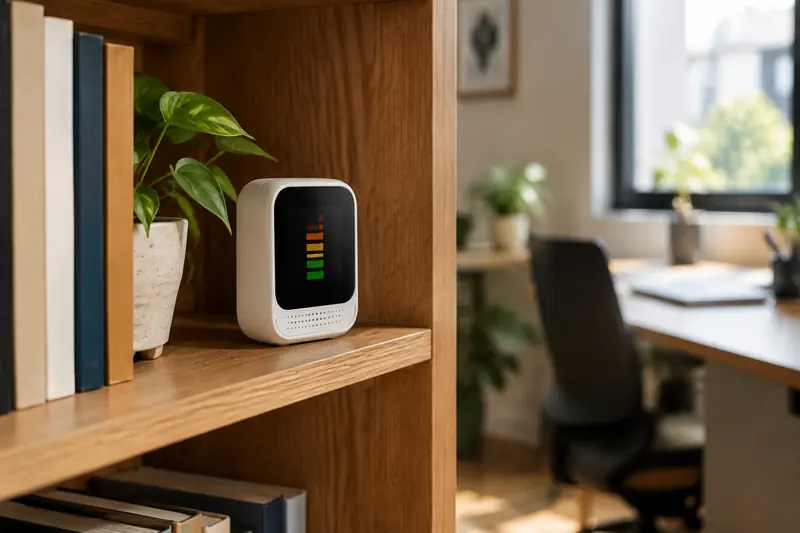
AI-made picture, not a photo of a real house What does an indoor air quality monitor measure?
A typical indoor air quality monitor measures carbon dioxide (CO2), fine particles (PM2.5), volatile organic compounds (VOCs), temperature and relative humidity.
Each number answers a different question. CO2 tracks how much fresh air a room gets for the people in it. PM2.5 tracks smoke and fine dust from cooking, candles, wildfires and outdoor air. VOCs track gases from paints, cleaners, fragrances and new furniture. Humidity tells you whether the house is drifting toward static and dry skin, or toward mold.
What each monitor reading tells you Reading What it tracks Reference point First response CO2 Fresh air per person in a room About 425 ppm outdoors; no ASHRAE indoor limit Bring in more outdoor air PM2.5 Smoke and fine dust EPA: 9.0 µg/m³ annual, 35 µg/m³ 24-hour Range hood, better filter, portable cleaner VOC / TVOC Gases from products and activities No shared scale; approximate Remove the source, ventilate Relative humidity Moisture in the air EPA: 30–50%, never above 60% for long Humidify or dehumidify toward the range Carbon monoxide Combustion gas Needs a UL 2034 CO alarm, not a monitor Alarm sounds: everyone out, call 911 from outside Turn over for the detail
A monitor does not clean anything. Its value is in showing cause and effect: the PM2.5 spike when the toast burns, the CO2 climb overnight in a closed bedroom, the slow fall after you start a fan. Read trends, not single numbers.
Source the documents listed on this stack's sources card
Next What CO2 reading on an air quality monitor is too high?↓What CO2 reading on an air quality monitor is too high?
There is no health-based indoor CO2 limit in ASHRAE's standards, so "too high" means "too little fresh air," not "dangerous." Outdoor air is about 425 ppm today; NOAA's Mauna Loa record shows a September 2026 monthly mean of 426.07 ppm. Indoors, CO2 rises above that as people breathe, and falls as outdoor air replaces room air.
Readings that climb well above outdoor levels, roughly 1,000 ppm and up, are a sign a room is under-ventilated, not a danger line. ASHRAE's 2025 position document on indoor carbon dioxide explains that its 1989 ventilation standard did carry a CO2 figure of 1,000 ppm, but it was removed from later editions because people misread it. The same document says CO2 is not an overall indicator of indoor air quality, though it is a useful tool if you understand its limits. For scale, the workplace limit it cites from OSHA and NIOSH is 5,000 ppm averaged over an 8-hour shift.
Turn over for the detail
Use a high CO2 reading as a prompt:
- A bedroom that climbs far past 1,000 ppm overnight with the door shut needs more air: leave the door ajar or run the ventilation system.
- A whole house that stays high points to too little planned ventilation. The page on why tight houses need ventilation and the ASHRAE 62.2 ventilation rate explain how much fresh air a home is meant to get.
- CO2 says nothing about particles, gases from cooking or radon. A low CO2 number is not a clean bill of health.
What PM2.5 numbers matter on an indoor air quality monitor?
The numbers that matter are EPA's outdoor benchmarks, used as a rough yardstick. In February 2024 EPA set the annual PM2.5 standard at 9.0 µg/m³ and kept the 24-hour standard at 35 µg/m³. EPA's 2024 Air Quality Index breakpoints for 24-hour PM2.5 run Good 0–9.0, Moderate 9.1–35.4, Unhealthy for Sensitive Groups 35.5–55.4, Unhealthy 55.5–125.4, Very Unhealthy 125.5–225.4 and Hazardous 225.5 and up.
Turn over for the detail
Two cautions. First, AirNow describes the AQI as EPA's tool for outdoor air quality, and its categories are based on 24-hour averages, while your monitor shows minute-by-minute readings. A short spike is not the same as a bad day. Second, cooking makes big spikes: Lawrence Berkeley National Laboratory measured single cooking events above 300 µg/m³ for short periods.
What to do with the readings:
- Spikes while cooking: run a range hood ducted outdoors; see gas stove ventilation.
- High levels that linger: upgrade the furnace filter (see MERV ratings) or run a portable cleaner sized by its smoke CADR (air purifier CADR).
- High levels during wildfire season: follow wildfire smoke indoors.
How much should you trust the VOC number?
Trust the VOC number for direction, not for its exact value. Consumer monitors report total VOCs, sometimes as an index and sometimes in ppb or µg/m³, and models from different makers aren't calibrated to a shared scale, so their readings are approximate.
The useful pattern is the jump. If the VOC reading leaps when you paint, use a spray cleaner, light a scented candle or unpack new furniture, the monitor has found a source. Reduce or remove the source and ventilate; EPA's guide to air cleaners notes that CADR ratings cover particles only, and that gas removal needs a unit with a substantial activated carbon filter. A reading that stays high with no obvious cause is worth a closer look, not alarm.
Why is a CO alarm a different device from an air quality monitor?
A carbon monoxide alarm is a life-safety device built and tested to sound before CO reaches life-threatening levels, while an air quality monitor is an information gadget. The CPSC says to install a CO alarm that meets the current UL 2034 standard, and that alarms are designed to alarm before life-threatening levels are reached. Even if your monitor shows a CO figure, it is not a substitute.
Video from the Seattle Fire Department channel on YouTube: Carbon Monoxide Alarms – what to do if the alarm sounds. That channel has no tie to Air in the House; nothing loads from YouTube except the still picture until you press play. Turn over for the detail
The CPSC's CO information center asks for battery-operated or battery-backup alarms on every level of the home and outside sleeping areas. It estimates more than 200 people in the US die each year from accidental non-fire CO poisoning linked to consumer products. CPSC also notes the test button checks the circuitry, not the sensor, so replace alarms at the age the maker states.
An alarm is no replacement for upkeep, either: the CPSC urges an annual professional inspection of fuel-burning appliances such as a furnace, water heater or fireplace, plus chimneys and flues. If you're unsure, call a licensed pro. Garages are a common CO source; see attached garage air.
Reference numbers for monitor readings
Chart drawn by Air in the House from figures cited in this stack.
Quick cards
Short questions people ask next, one answer each.
Where should you put an indoor air quality monitor?
Set it where your household spends most waking hours, at roughly breathing height, away from the stove, a humidifier's mist, open windows and direct sun. A bedroom is a good second spot, because CO2 builds overnight with the door shut.
Why does my monitor's CO2 jump when people come over?
Every person breathes out CO2, so a full living room climbs fast. It is a sign the room needs more outdoor air while guests are there, not a health emergency.
Is PM2.5 from a candle or toaster worth worrying about?
Short spikes from candles, toast or searing are common and clear once the source stops and air moves. Readings that stay high for hours deserve a filter upgrade or a portable cleaner.
Do air quality monitors need calibration?
Follow the maker's manual, since methods differ by model. A CO2 reading that sits far below outdoor air's 425 ppm suggests the sensor is off.
Can a monitor detect radon?
No, standard air quality monitors do not measure radon. Radon needs a dedicated test kit or radon monitor; see radon testing.
What humidity should an air quality monitor show?
Keep indoor humidity between 30% and 50% (EPA) and never let it stay above 60%. In cold weather, nearer 30–40% if windows sweat; see indoor humidity in winter.
Where these cards come from
This stack rests on NOAA's Mauna Loa CO2 record, ASHRAE's 2025 position document on indoor carbon dioxide, EPA's 2024 PM2.5 standard and AQI breakpoints, AirNow, a Lawrence Berkeley National Laboratory report and CPSC carbon monoxide guidance, read in October 2026. It does not rank or name monitors, and it makes no claims about sensor accuracy, because no primary source testing consumer monitors was found.
- NOAA NOAA, Mauna Loa, 2026
- ASHRAE position document on indoor carbon dioxide
- EPA annual PM2.5 standard at 9.0 µg/m³
- EPA Air Quality Index breakpoints
- AirNow EPA's tool for outdoor air quality
- Berkeley Lab measured single cooking events above 300 µg/m³
- EPA guide to air cleaners
- CPSC install a CO alarm that meets the current UL 2034 standard
- CPSC CO information center
Cards are written by the Air in the House editors from the documents above and dated when they were last checked. How stacks are made