Kitchen · stack · 6 quick cards
Gas Stove Ventilation: Clear the Air
8 cards · By the Air in the House editors, from EPA, Berkeley Lab, CPSC · how stacks are made · Updated
How do you clear the air around a gas stove?
Gas stove ventilation works best with a hood ducted outdoors, switched on high for every cooking session, pans on the back burners, and a CO alarm nearby.
- The EPA says homes with gas stoves often have higher nitrogen dioxide indoors than outside.
- EPA says carbon monoxide near properly adjusted gas stoves is often 5–15 ppm, and 30 ppm or more near poorly adjusted ones.
- Lawrence Berkeley National Laboratory found hoods on high caught more than 90% of back-burner exhaust in the best cases, but less than 40% from front burners on low settings.
- EPA's advice is to install and use an exhaust fan vented outdoors over a gas stove.
- The CPSC recommends CO alarms on every level of the home and outside sleeping areas.
- CPSC estimates more than 200 people in the US die each year from accidental non-fire CO poisoning linked to consumer products.
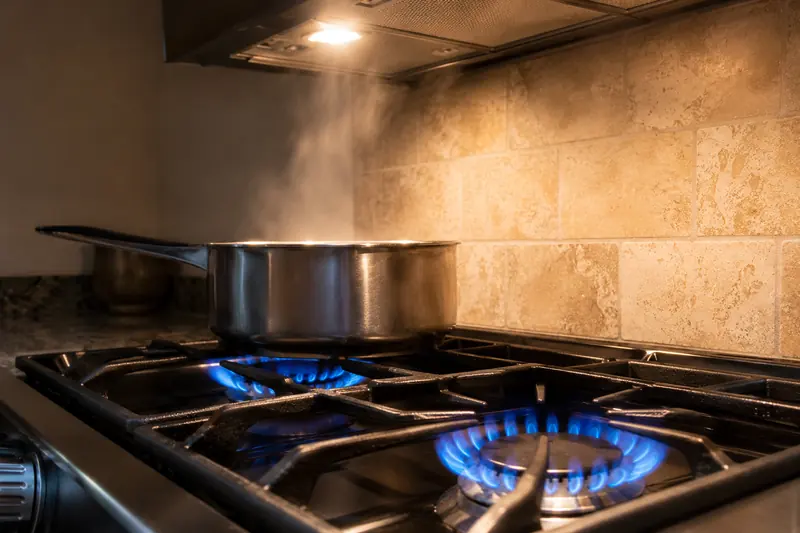
AI-made picture, not a photo of a real house What does a gas stove put into the air?
A gas burner gives off nitrogen dioxide (NO2) every time it runs, and under some conditions carbon monoxide (CO), formaldehyde and ultrafine particles too. That list comes from a Lawrence Berkeley National Laboratory (LBNL) review of kitchen pollutants, which also found that single cooking events can push short-term fine-particle (PM2.5) levels above 300 µg/m³. LBNL is clear that cooking food itself, on electric coils as well as gas, also produces pollutants, so the hood earns its keep on any range.
What a gas cooktop adds to kitchen air Pollutant Where it comes from What helps most Nitrogen dioxide (NO2) Every gas flame A hood ducted outdoors, run on high Carbon monoxide (CO) Burners, more when poorly adjusted Annual professional check; CO alarm Fine particles (PM2.5) Searing, frying, burned food Back burners, hood on high Moisture Burner combustion and boiling pots Ducted hood; recirculating filters don't remove it Formaldehyde, ultrafine particles Burners under some conditions Capture at the source Turn over for the detail
The EPA's nitrogen dioxide page names gas stoves as a main indoor source. In homes without combustion appliances, indoor NO2 averages about half the outdoor level; with a gas stove, it often runs higher than outdoors. NO2 irritates the eyes, nose, throat and airways, and EPA notes low-level exposure may raise the risk of respiratory infections, especially in young children. There's no agreed indoor NO2 standard.
For CO, the EPA's carbon monoxide page gives 0.5 to 5 ppm as typical for homes without gas stoves, 5 to 15 ppm near properly adjusted stoves, and 30 ppm or higher near poorly adjusted ones. That gap is why EPA's first tip is to keep gas appliances properly adjusted.
How well do range hoods capture it?
A good hood catches most of a back burner's exhaust and much less from the front. In LBNL's 2011 lab study, hoods on their top setting captured more than 90% (two models) and more than 80% (one model) of back-burner exhaust, but just 46–78% from front burners. On quieter, lower settings, they still caught more than half of the back-burner exhaust but less than 40% from the front.
Turn over for the detail
The authors expect real kitchens to do worse than the lab. Over-the-range microwaves were tested separately: a separate LBNL study measured 40–85% capture for front burners and 60–100% for back burners. For sizing and shape, see range hood CFM.
How should you use the hood?
Turn the hood on high and cook on the back burners; LBNL's conclusion is that common hoods can remove pollutants well when used exactly that way. The same lab's best-practice list adds two habits: run the ventilation during and after every cooking event, and clean the grease screens regularly so airflow doesn't drop.
In practice, that means:
Turn over for the detail
- Switch the hood on before you light the burner.
- Boil, sear and fry on the back burners.
- Leave the hood running for a while after the burners are off.
- Wash or swap the filters as often as the manual says.
LBNL counts loudness among the top reasons people skip the hood, so a quiet model you actually run beats a loud one. A hood that only recirculates won't remove NO2, CO or moisture; ducted vs recirculating hoods explains why.
Source the documents listed on this stack's sources card
Next What if you have no vented hood?↓What if you have no vented hood?
Without a ducted hood, the next best thing is exhaust as close to the stove as possible. LBNL found that a downdraft vent or a well-placed wall or ceiling exhaust fan near the cooktop beats a fan elsewhere in the house, because kitchen ventilation works best closest to the source. The International Residential Code allows a listed ductless hood only where other ventilation is provided.
Turn over for the detail
A recirculating hood still helps with grease and some odor, but none sold for homes claims to take out carbon monoxide or moisture, LBNL found. Keep the back-burner habit, check that the home's whole-house ventilation is running if it has one, and consider adding a ducted hood at the next remodel. Running a new duct out through a wall or roof is a contractor's work, and the electrical hookup needs a licensed electrician. If you're unsure, call a licensed pro.
Source the documents listed on this stack's sources card
Next Why keep a CO alarm nearby?↓Why keep a CO alarm nearby?
You can't see or smell carbon monoxide, and a burner or oven that drifts out of adjustment can raise it without any warning sign. The CPSC recommends battery-operated CO alarms, or alarms with battery backup, on every level of the home and outside sleeping areas; interconnected alarms are best. "Nearby" means the same floor, not the kitchen itself: CPSC does not recommend putting a CO alarm in a kitchen or above a fuel-burning appliance.
Turn over for the detail
The CPSC's CO questions page adds three points. Buy an alarm that meets the current UL 2034 standard; know that the test button checks the circuit, not the sensor's accuracy; and replace it at the age its maker gives. Most people feel no symptoms below about 70 ppm (though some heart patients may notice more chest pain), but sustained levels above 150 to 200 ppm can cause disorientation, unconsciousness and death.
An alarm is a backup, not a substitute for upkeep. CPSC urges a yearly professional inspection of every fuel-burning appliance, stove included. A smart-home air monitor is not a CO alarm; see indoor air quality monitors.
What should you do if you smell gas?
Leave right away with everyone, and do the same if a CO alarm sounds. On the way out, don't touch light switches, appliances or phones, and don't go looking for the source. Once you're outside and away from the building, call 911 or your gas utility. The CPSC's 2026 winter safety release gives the same order: get out first, then call from outside.
Video from the Berkeley Lab channel on YouTube: Looking for Hazardous Pollutants in Your Kitchen. That channel has no tie to Air in the House; nothing loads from YouTube except the still picture until you press play. Gas stove air, by the numbers
- 5–15 ppmCO near a properly adjusted gas stoveEPA
- 30 ppm or moreCO near a poorly adjusted gas stoveEPA
- 300 µg/m³short-term PM2.5 a single cooking event can exceedLawrence Berkeley National Laboratory
- <40%front-burner capture on low hood settingsLawrence Berkeley National Laboratory
- more than 200US deaths a year from non-fire CO poisoning tied to consumer productsCPSC
Chart drawn by Air in the House from figures cited in this stack. Source EPA · Berkeley Lab · CPSC
Next Quick cards↓
Quick cards
Short questions people ask next, one answer each.
Should the hood run even when you only boil water?
Yes. The burner makes NO2 whatever is in the pot, and boiling adds moisture, so the hood is worth running on high for every gas cooking session, not just for frying.
Does the oven need the hood on too?
A gas oven burns gas too, so running the hood while it's on makes sense. LBNL's capture studies focused on cooktop burners, but exhaust near the source, ducted outdoors, still applies.
Can you line the bottom of a gas oven with foil?
No. The CPSC warns that covering the bottom of a natural gas or propane oven with aluminum foil blocks the appliance's combustion air flow and can produce CO. Use a baking sheet on a rack below the food instead, if the oven's manual allows it.
Can a gas stove trip a CO alarm during normal cooking?
Treat every CO alarm as real, whatever is on the stove: get everyone out without flipping switches, using phones or looking for the cause, then call 911 or your gas utility once outside. A single short chirp about every 30 seconds is different: on many alarms it is the end-of-life or low-battery signal, so check the alarm's manual and replace it.
Do children react more to gas stove fumes?
EPA notes that low-level NO2 exposure may raise the risk of respiratory infections, especially in young children. That's one more reason to run the hood on high and use the back burners when kids are around the kitchen.
Is it safe to heat a room with a gas oven?
No. The CPSC says never to use gas appliances such as ranges, ovens or clothes dryers to heat your home; running them for warmth adds hours of combustion gases to the air.
Where these cards come from
Read for this stack in October 2026: EPA's pages on nitrogen dioxide and carbon monoxide, the CPSC's CO information center, its CO questions page and its 2026 winter safety release, the 2024 International Residential Code, and LBNL's kitchen-pollutant review plus two hood capture studies. Not included: health-study headlines we could not trace to a primary source, any stove or hood brand advice, and gas-stove rulemaking news.
- EPA EPA
- Berkeley Lab Lawrence Berkeley National Laboratory (LBNL) review
- EPA EPA's carbon monoxide page
- Berkeley Lab 2011 lab study
- Berkeley Lab separate LBNL study
- CPSC CPSC
- CPSC CPSC's CO questions page
- CPSC CPSC's 2026 winter safety release
Cards are written by the Air in the House editors from the documents above and dated when they were last checked. How stacks are made