Kitchen · stack · 6 quick cards
Range Hood CFM: Sizing a Hood That Works
8 cards · By the Air in the House editors, from Home Ventilating Institute, Berkeley Lab, International Residential Code, U.S. Department of Energy and other documents · how stacks are made · Updated · this stack links to businesses tied to our owners, and each link says how
How much airflow does a range hood need?
Range hood CFM for most home kitchens: about 100 cfm per linear foot of cooktop for a wall hood and 150 for an island hood (HVI), never below the 100 cfm code floor.
- The Home Ventilating Institute recommends about 100 cfm per linear foot of range for a wall hood and 150 cfm per foot for an island hood.
- A 30-inch range against a wall works out to roughly 250 cfm by HVI's table; HVI's bare minimum for that width is 100 cfm.
- The 2024 International Residential Code sets the kitchen floor at 100 cfm when the fan is switched on, or 25 cfm if it runs continuously.
- Lawrence Berkeley National Laboratory found hoods caught more than 90% of back-burner exhaust on high, but as little as 46% from front burners.
- Above 400 cfm, a home with a gas, oil or wood appliance that isn't sealed-combustion or power-vented needs makeup air under IRC section M1503.6.
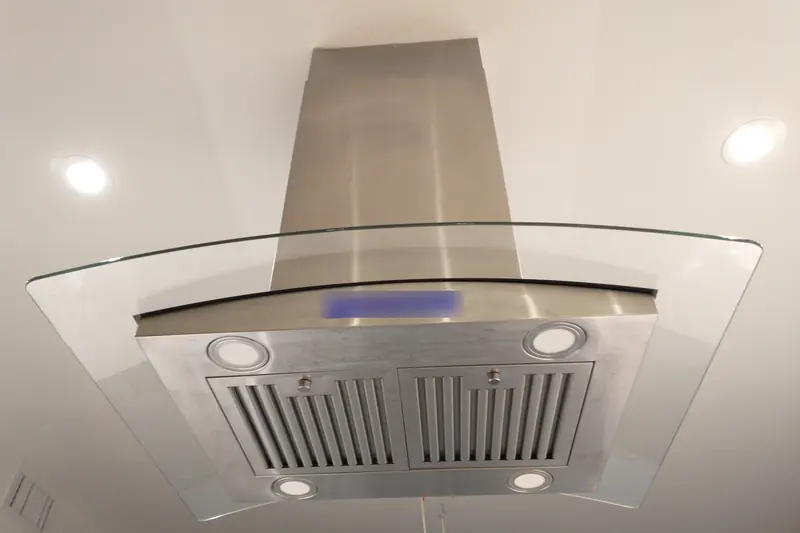
How much range hood CFM do you need?
For a hood on a wall, start at about 100 cfm per linear foot of cooktop; for an island hood, about 150 cfm per foot. Those are the recommended rates in the Home Ventilating Institute's range hood brochure, which also lists minimums of 40 cfm per foot against a wall and 50 cfm per foot over an island.
Turned into hood widths, HVI's wall-hood table reads 250 cfm for a 30-inch range, 300 cfm for 36 inches and 400 cfm for 48 inches. The same per-foot arithmetic gives an island hood over a 36-inch cooktop about 450 cfm, which already crosses the line where makeup air can come into play (more on that below). HVI adds that frequent high-heat cooking calls for a stronger hood.
HVI range hood airflow by width (hood against a wall) Range width HVI recommended HVI minimum 30-inch range (2.5 ft) 250 cfm 100 cfm 36-inch range (3 ft) 300 cfm 120 cfm 48-inch range (4 ft) 400 cfm 160 cfm Island hood, any width 150 cfm per foot 50 cfm per foot Why does the hood's shape matter as much as CFM?
A hood only removes what it catches, and how much it catches depends on its shape and how far it reaches over the burners. In a 2011 Lawrence Berkeley National Laboratory (LBNL) study, hoods on their highest setting captured more than 90% (two hoods) and more than 80% (one hood) of the exhaust from a back burner, but only 46–78% from a front burner.
Turn over for the detail
The same lab's 2014 review of kitchen ventilation found that hoods moving the same airflow differed in capture by as much as a factor of three. Deep canopies that hold the rising plume beat flat, shallow ones. The review's best-practice list asks for a hood that covers the front burners, can move 200 cfm when rated at 0.25 in. of static pressure, and stays under 3 sones.
Over-the-range microwaves are the weak spot: LBNL measured them catching 40–85% of front-burner exhaust and 60–100% from back burners.
How should the hood be mounted?
HVI's advice is short: the hood's width should match the cooking range, and it should hang at the height the manufacturer recommends above the cooking surface. Within the heights LBNL tested (roughly 14 to 30 inches), capture changed less with height than with airflow and hood design, but pulling a hood forward, away from the wall, made back-burner capture worse.
Turn over for the detail
Island hoods get the higher HVI figure; with no back wall, the rising plume has more room to drift away from the canopy. Between two models, a canopy deep enough to cover the front burners beats a few extra cfm; LBNL found that coverage improves front-burner capture greatly.
Hooking a hood up to power belongs to a licensed electrician, and taking its duct through a wall or roof belongs to a contractor or roofer who can flash it. If you're unsure, call a licensed pro. Get the hood's manual first.
Source the documents listed on this stack's sources card
Next What do the code minimums say?↓What do the code minimums say?
The code minimum is low: IRC Table M1505.5 asks for 100 cfm from a kitchen fan that's switched on when needed, or 25 cfm from one that runs all the time. ASHRAE 62.2, the national residential ventilation standard, matches the 100 cfm on-demand figure but sets always-on kitchen exhaust at 5 air changes per hour of the kitchen's volume instead, as summarized in this Department of Energy profile.
Turn over for the detail
The same IRC chapter says a ducted hood must discharge outdoors through a smooth, airtight duct with a backdraft damper, kept separate from every other exhaust system. The duct may not end in an attic, a crawl space or anywhere else inside the house, and it must be galvanized steel, stainless steel or copper. Listed ductless hoods are allowed where other ventilation is provided; see ductless range hood vs ducted for what that trade-off costs you.
HVI notes there are no government standards for rating hood performance, so prefer HVI-certified ratings. Local rules can be stricter, and the building department has the final word.
How do duct size and length change airflow?
A fan's rated cfm is what it moves against a set test resistance, and every extra foot of duct, elbow, transition and wall cap adds resistance that cuts real airflow. HVI's brochure names the three big factors as the duct's width, its number of bends and its length. LBNL adds the material (smooth metal versus accordion flex) and the outside fitting; more resistance also means more noise.
Turn over for the detail
In the field, LBNL reports that duct resistance in many homes is well above the 0.10 in. of static pressure at which many hoods are rated. Long, twisting runs, tight transitions, restrictive caps and dampers that can't open fully are the usual causes. Ask the installer for a short, straight run at the diameter the hood's manual calls for.
Rigid metal duct is what the code requires for kitchen exhaust. For an idea of what's sold, Plumbing Supply and More carries a sheet-metal duct category (Plumbing Supply and More, owned by the people behind Air in the House) of round pipe and fittings.
Source the documents listed on this stack's sources card
Next When does a bigger hood cause problems?↓When does a bigger hood cause problems?
A hood that moves more than 400 cfm can pull enough air out of a tight house to cause trouble, which is why the code ties a makeup-air rule to that size. Under IRC section M1503.6, a home with a gas, oil or wood appliance that isn't direct-vent or power-vented inside the air barrier needs makeup air for any exhaust system able to move more than 400 cfm, at roughly the hood's own rate.
Video from the Broan-NuTone channel on YouTube: How do I determine the size of the range hood I need? - Danny Lipford. That channel has no tie to Air in the House; nothing loads from YouTube except the still picture until you press play. Turn over for the detail
The worry is backdrafting: a strong hood can lower house pressure enough to pull flue gases from a water heater or furnace back into the rooms. Makeup air for range hoods explains the combustion safety test a qualified pro runs to check this. The CPSC advises a working CO alarm on each floor and outside sleeping areas.
Noise matters too, because a loud hood is a hood nobody runs. ENERGY STAR's criteria cap qualifying range hoods (75 watts or less) at 2.0 sones, and HVI compares 1 sone to a quiet refrigerator in a quiet kitchen. For cooking habits that make any hood work better, see gas stove ventilation.
Range hood numbers to know
- 100 cfm per footHVI recommended rate for a wall hoodHome Ventilating Institute
- 150 cfm per footHVI recommended rate for an island hoodHome Ventilating Institute
- 100 cfmcode minimum for an on-demand kitchen fan2024 IRC Table M1505.5
- 400 cfmhood rating that can trigger the makeup-air ruleInternational Residential Code
- >90%back-burner capture by the best hoods on highLawrence Berkeley National Laboratory
Chart drawn by Air in the House from figures cited in this stack.
Quick cards
Short questions people ask next, one answer each.
Is 600 cfm too much for a home range hood?
It can be. A 600 cfm hood is above the 400 cfm line in IRC M1503.6, so a home with a water heater, furnace or fireplace inside the air barrier that isn't sealed-combustion or power-vented needs makeup air, and many towns require it regardless.
Does a professional-style range need a bigger hood?
Generally yes. The Pennsylvania Housing Research Center notes that high-powered, commercial-style cooking equipment needs a higher exhaust rate and that installers should check the equipment's own specifications. Read the range maker's installation manual for its hood recommendation, then settle the makeup-air question before you buy.
Is the cfm on the box the airflow you will actually get?
Usually not. Ratings are measured against a set test resistance, and long ducts, elbows, small caps and sticky dampers all lower real airflow.
Should a range hood be wider than the cooktop?
HVI's guidance is that the hood width should match the range. Depth matters as much as width: a canopy that reaches over the front burners catches far more of what they give off.
How loud should a range hood be?
Quiet enough that you'll run it. ENERGY STAR-qualified range hoods are capped at 2.0 sones, and LBNL's best-practice list asks for under 3 sones at 200 cfm or more.
Can you put a stronger hood on the old duct?
Not without checking the duct first. Lawrence Berkeley National Laboratory found that real duct runs in many homes push back harder than the 0.10 in. of static pressure hoods are rated at, so a bigger fan on a small or long duct delivers far less than its label. Ask the installer to compare the duct size with the new hood's instructions, and remember that above 400 cfm the makeup-air rule may apply.
Parts and pages this stack names
About these links: the people behind Air in the House also own Plumbing Supply and More, SoftPro Water Systems and Quality Water Treatment, and work with Central Plumbing & HVAC. Nobody pays to be mentioned here. Our notes on these cards are ours; what a linked page says is that business's own claim. Who owns this site
Sheet-metal duct
Plumbing Supply and More · owned by the people behind Air in the House
Parts an installer uses on an exhaust or ventilation run, shown so a quote makes sense. Cutting through a wall or roof and any wiring are jobs for pros.
Open Plumbing Supply and More
Where these cards come from
Sources, checked in October 2026: the Home Ventilating Institute's range hood brochure, chapter 15 of the 2024 International Residential Code, a Department of Energy summary of ASHRAE 62.2, ENERGY STAR's ventilation fan criteria, a Pennsylvania Housing Research Center builder brief and three LBNL papers on hood capture. Deliberately left out: brand and model picks, prices and the burner-BTU sizing rule, which no primary source we read supports.
- Home Ventilating Institute Home Ventilating Institute
- Berkeley Lab 2011 Lawrence Berkeley National Laboratory (LBNL) study
- Berkeley Lab 2014 review of kitchen ventilation
- International Residential Code IRC Table M1505.5
- U.S. Department of Energy Department of Energy profile
- ENERGY STAR ENERGY STAR's criteria
Cards are written by the Air in the House editors from the documents above and dated when they were last checked. How stacks are made