Kitchen · stack · 6 quick cards
Ductless Range Hood or Ducted Hood?
7 cards · By the Air in the House editors, from International Residential Code, Berkeley Lab, EPA, U.S. Department of Energy and other documents · how stacks are made · Updated · this stack links to businesses tied to our owners, and each link says how
Ducted or recirculating: which hood should you get?
A ductless range hood filters grease and some odor, then blows the air back into the kitchen; only a hood ducted outdoors removes moisture, heat, carbon monoxide and nitrogen dioxide.
- Lawrence Berkeley National Laboratory knew of no residential recirculating product that even claims to remove CO or water vapor.
- The 2024 IRC allows a listed ductless hood only where other mechanical or natural ventilation is provided.
- Under IRC M1503.3 and M1503.4, a hood duct must be smooth, airtight, metal (galvanized, stainless or copper), with a backdraft damper, and may never end in an attic or crawl space.
- The EPA's advice for gas cooking is an exhaust fan vented outdoors.
- LBNL reports that many over-the-range microwaves ship set to recirculate, and some vented installs never get switched over.
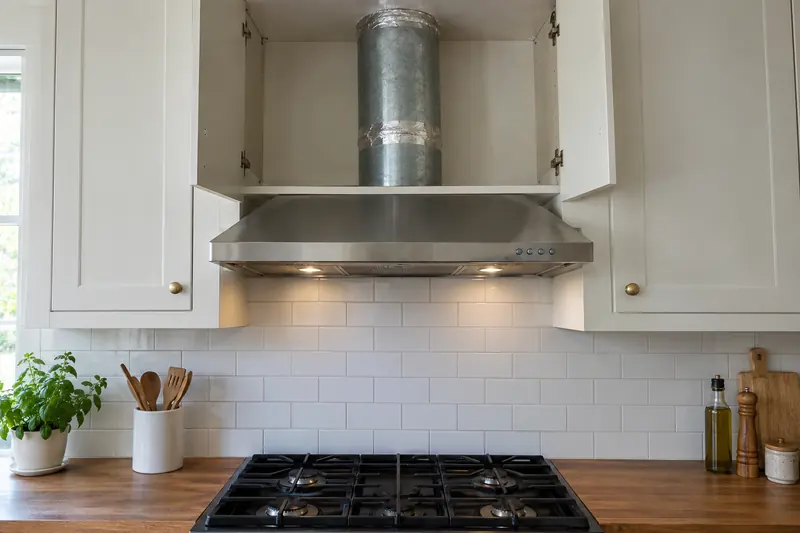
AI-made picture, not a photo of a real house What does a ductless range hood actually do?
A ductless (recirculating) range hood pulls kitchen air through a grease filter, usually followed by a charcoal filter, and blows it back into the room. The grease filter keeps fat off cabinets and ceiling; the charcoal is meant to take the edge off cooking odors. Nothing leaves the house.
A Lawrence Berkeley National Laboratory (LBNL) review of kitchen ventilation found that many recirculating hoods claim to remove smoke and odors and a few claim to remove some pollutants, but it knew of no residential product that claims to remove CO or water vapor. The authors wrote that there is significant doubt about how well these hoods remove any of these pollutants, and that better-filtered models were only beginning to reach the market.
Video from the California Air Resources Board channel on YouTube: ARB Research Seminars - Kitchen Solutions to Indoor Air Pollution Hazards. That channel has no tie to Air in the House; nothing loads from YouTube except the still picture until you press play. Turn over for the detail
The International Residential Code treats them as an exception: listed and labeled ductless hoods don't have to discharge outdoors, as long as they're installed per the maker's instructions and other ventilation is provided.
What does a ducted hood remove that a ductless one can't?
A ducted hood sends the whole cooking plume outdoors, including the things no filter catches: water vapor, heat, carbon monoxide and nitrogen dioxide. That matters most over a gas cooktop. The EPA's nitrogen dioxide page says homes with gas stoves often have higher NO2 indoors than outdoors, and its advice is to install and use an exhaust fan vented to the outdoors over the stove.
Ducted vs ductless: what leaves the kitchen What cooking makes Ducted hood (vented outdoors) Ductless hood (recirculating) Grease Caught by filters, rest sent outside Caught by the grease filter Odors and smoke Sent outside Partly reduced by charcoal; efficacy in doubt (LBNL) Water vapor Sent outside Returned to the room Carbon monoxide Sent outside No product claims to remove it (LBNL) Nitrogen dioxide Sent outside Not shown to be removed Heat Sent outside Returned to the room Turn over for the detail
Moisture is the other big difference. A pot of pasta or a sink of steaming dishes puts water into the air that a charcoal filter can't hold; ducted out, far less of it reaches cold windows. For what burners add to the air, see gas stove ventilation; for winter moisture, see condensation on windows.
When is a ductless hood the only option?
A ductless hood is the fallback when no duct can reach outdoors: an apartment or condo with no exterior wall at the kitchen, association rules against new wall caps, or an interior island with no path through the floor or ceiling. LBNL also notes that some high-performance home builders choose recirculating hoods to avoid another hole in the envelope, pairing them with a heat or energy recovery ventilator that draws continuously from the kitchen. ASHRAE 62.2 accepts continuous kitchen exhaust of 5 air changes per hour of the kitchen's volume in place of a 100 cfm on-demand fan.
Turn over for the detail
If that's your kitchen, make up the difference elsewhere. Cook on the back burners, keep the whole-house ventilation running, and ask whether an ERV or HRV can take a kitchen exhaust point. A recirculating hood still beats nothing for grease. If you have an over-the-range microwave, check its setting: LBNL reports many ship with the internal baffle set to recirculate, and some installed with a duct still recirculate because nobody changed it. The microwaves LBNL measured caught only 40–85% of front-burner exhaust.
How should a ducted hood be ducted?
Run it short, straight, smooth and sealed, all the way outdoors. IRC section M1503.3 requires a smooth-walled, airtight duct with a backdraft damper, kept separate from every other exhaust system, ending outdoors and never in an attic, crawl space or other indoor area. Section M1503.4 limits the material to galvanized steel, stainless steel or copper. The exhaust opening also needs clearance: at least 3 feet from property lines, operable windows and doors, and 10 feet from mechanical air intakes, with some exceptions.
Turn over for the detail
Every foot and fitting costs airflow. The Home Ventilating Institute names the duct's width, number of bends and length as what decides its efficiency. LBNL adds the material, transitions and the outside fitting, and reports that many homes have duct resistance well above the 0.10 in. of static pressure at which hoods are rated, often from long or convoluted runs, restrictive caps and dampers that can't open fully.
Use the duct size the hood's manual specifies and seal every joint. Plumbing Supply and More sells round duct pipe and fittings (Plumbing Supply and More, owned by the people behind Air in the House), and aluminum foil HVAC tape (Plumbing Supply and More, owned by the people behind Air in the House) is one common way installers seal seams. Wiring the hood is a licensed electrician's job, and a new wall or roof penetration should be cut and flashed by a contractor or roofer. If you're unsure, call a licensed pro. A hood strong enough to need makeup air (over 400 cfm in many homes) also needs a combustion safety check.
How do you look after the filters?
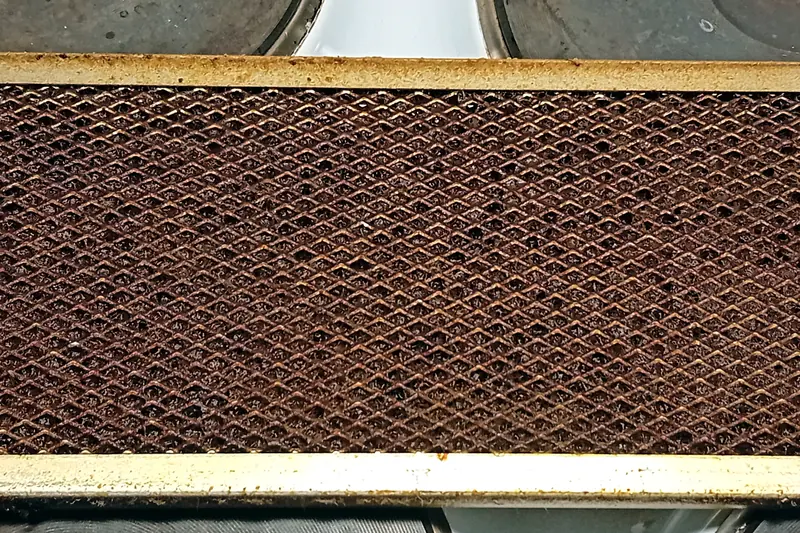
Clean metal grease filters regularly, and replace charcoal filters on the schedule in the hood's manual. LBNL's best-practice list for range hoods includes cleaning grease screens regularly to maintain airflow, because a clogged mesh like the one above chokes the airflow.
Most metal mesh and baffle filters slide or snap out and can be washed; the manual says whether that means hot soapy water or the dishwasher. Most charcoal (carbon) filters are replaced rather than washed, so a ductless hood only keeps reducing odors if the charcoal is changed when the manual says. Turn the hood off before removing filters, and let them dry fully before refitting.
Source the documents listed on this stack's sources card
Next Ducted and ductless, by the numbers↓Ducted and ductless, by the numbers
- 100 cfmcode minimum airflow for an on-demand kitchen hoodInternational Residential Code (2024)
- 3 feetminimum clearance from an exhaust outlet to operable windows, doors and property linesInternational Residential Code (2024)
- 10 feetminimum clearance from an exhaust outlet to a mechanical air intakeInternational Residential Code (2024)
- 0.10 in.static pressure many hoods are rated at; real ducts often exceed itLawrence Berkeley National Laboratory
Chart drawn by Air in the House from figures cited in this stack.
Quick cards
Short questions people ask next, one answer each.
Do ductless hoods use charcoal or carbon filters?
The two words mean the same thing here: activated carbon, often called charcoal. It sits after the grease filter and is meant for odors; it doesn't remove moisture or carbon monoxide.
Can a ductless hood be converted to ducted later?
Many hoods are sold convertible, with the charcoal filter removed and a duct connected to the top or back outlet. Check the manual for the outlet size and duct route, and plan the wall or roof penetration with a contractor.
Is a ductless hood allowed over a gas range?
The IRC allows listed ductless hoods where other ventilation is provided, but local codes and the range maker's instructions may ask for more. Given what gas burners give off, a ducted hood is the better choice whenever a duct can reach outdoors.
Why does my ducted hood blow air back into the kitchen?
Often it's an over-the-range microwave or convertible hood still set to recirculate. LBNL notes many microwaves ship that way; the manual shows how to turn the internal damper or plate to send air up the duct.
Can flexible foil duct be used for a range hood?
The IRC calls for a smooth interior surface and lists galvanized steel, stainless steel or copper for cooking exhaust, so ribbed foil flex duct doesn't meet it. LBNL also notes accordion flex adds resistance.
Does the outside wall cap matter?
Yes. LBNL lists restrictive roof and wall caps among the main causes of excess duct resistance, and the code requires a backdraft damper that must open freely. A cap matched to the full duct size keeps airflow up.
Parts and pages this stack names
About these links: the people behind Air in the House also own Plumbing Supply and More, SoftPro Water Systems and Quality Water Treatment, and work with Central Plumbing & HVAC. Nobody pays to be mentioned here. Our notes on these cards are ours; what a linked page says is that business's own claim. Who owns this site
Duct pipe and fittings
Plumbing Supply and More · owned by the people behind Air in the House
Parts an installer uses on an exhaust or ventilation run, shown so a quote makes sense. Cutting through a wall or roof and any wiring are jobs for pros.
Open Plumbing Supply and MoreAluminum foil HVAC tape
Plumbing Supply and More · owned by the people behind Air in the House
Parts an installer uses on an exhaust or ventilation run, shown so a quote makes sense. Cutting through a wall or roof and any wiring are jobs for pros.
Open Plumbing Supply and More
Where these cards come from
Sources read in October 2026: the 2024 International Residential Code's exhaust chapter, the Home Ventilating Institute's range hood brochure, the EPA's nitrogen dioxide page and LBNL's 2014 review of kitchen ventilation. No hood or filter brands are rated here, and filter-change intervals are left to each maker's manual because no primary source gives one figure for all hoods.
- International Residential Code 2024 IRC
- Berkeley Lab Lawrence Berkeley National Laboratory (LBNL) review
- EPA EPA's nitrogen dioxide page
- U.S. Department of Energy ASHRAE 62.2
- Berkeley Lab measured
- Home Ventilating Institute Home Ventilating Institute
Cards are written by the Air in the House editors from the documents above and dated when they were last checked. How stacks are made