Filters and cleaners · stack · 7 quick cards
Air Purifier CADR and Room Size
7 cards · By the Air in the House editors, from AHAM Verifide, EPA, California Air Resources Board · how stacks are made · Updated
How big an air purifier does your room need?
Air purifier CADR is the clean air delivery rate in cubic feet per minute; pick a tobacco-smoke CADR of at least two-thirds of the room's floor area, so 120 sq ft needs about 80.
- The AHAM seal lists three CADRs, for tobacco smoke, pollen and dust, measured under the ANSI/AHAM AC-1 test.
- AHAM's 2/3 rule: the smoke CADR should be at least two-thirds of the floor area, so a 10 × 12 ft room (120 sq ft) needs 80 or more.
- EPA's sizing table assumes an 8-foot ceiling: 100 sq ft calls for 65 cfm, 300 sq ft for 195, 600 sq ft for 390.
- EPA says the smoke number stands for the smallest particles, so read it first for PM2.5.
- CADR is usually measured at the top fan speed, and it covers particles only, not gases or odors.
- A HEPA filter traps 99.97% or more of 0.3 µm particles, but the CADR shows how much clean air reaches the room.
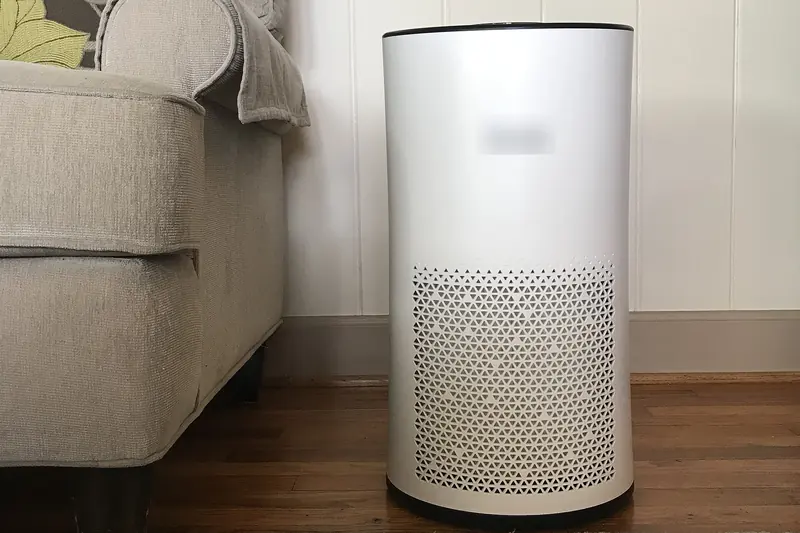
What does air purifier CADR mean?
Air purifier CADR, the clean air delivery rate, is the volume of filtered air a portable cleaner delivers, in cubic feet per minute. A higher number means the unit cleans a room's air faster. The Association of Home Appliance Manufacturers runs the certification program, and its seal, usually on the back or side of the box, lists three numbers: one for tobacco smoke, one for pollen and one for dust.
Turn over for the detail
Those three numbers come from the ANSI/AHAM AC-1 test, which is why they can be compared from one maker to another. EPA's home air cleaner guide adds two limits worth knowing. The rating is typically measured at the cleaner's highest speed, and the CADR system covers particles only, so it says nothing about smells or chemical vapors.
Two other labels are easy to confuse with CADR. An ENERGY STAR mark on an air cleaner is about energy efficiency, and EPA says it "does not refer to its air-cleaning effectiveness in any way." The ENERGY STAR room air cleaner specification does set a floor of a smoke CADR of 30 for a model to qualify, but that is a minimum, not a recommendation. And EPA itself neither certifies nor recommends brands or models. A third mark matters only for electronic units: the California Air Resources Board's certified list covers ozone emissions and electrical safety, and CARB says certification does not reflect how well a unit cleans.
How big a CADR does your room need?
Use AHAM's room-area rule, the 2/3 rule: the tobacco-smoke CADR should be at least two-thirds of the room's floor area in square feet. AHAM's own example is a 10 × 12 ft room of 120 sq ft, which needs a smoke CADR of at least 80. A smaller room simply gets its air cleaned more often.
Multiply length by width and compare the result with the box. EPA's version of the rule is a table built on an 8-foot ceiling. EPA's figures run a little under AHAM's arithmetic at the large end (390 for 600 sq ft, where two-thirds would be 400), so when the two disagree, take the higher number.
Minimum smoke CADR by room size (EPA, 8-ft ceiling) Room Floor area Smoke CADR, at least Small bedroom or office 100 sq ft 65 cfm Primary bedroom 200 sq ft 130 cfm Family room 300 sq ft 195 cfm Open living and dining area 400 sq ft 260 cfm Large open-plan space 500 sq ft 325 cfm Great room or studio apartment 600 sq ft 390 cfm Turn over for the detail
Adjust for the room you actually have. AHAM says ceilings higher than 8 feet call for a cleaner rated for a larger room. EPA says an open floor plan should be counted as the whole space the cleaner serves, and that an area bigger than any single product can handle may need more than one unit.
Source the documents listed on this stack's sources card
Next Why is the smoke number the one to read?↓Why is the smoke number the one to read?
Because it stands for the smallest particles, the ones that are hardest to catch and of greatest health concern. EPA explains that the tobacco-smoke, dust and pollen ratings represent small, medium and large particles, and its advice is direct: to remove small particles, choose a cleaner with a high CADR for tobacco smoke. That covers PM2.5 from cooking, candles and outdoor smoke that leaks in. On smoke days, EPA's clean room advice uses the same sizing for the one room you keep sealed up.
Video from the Spokane Regional Clean Air Agency channel on YouTube: How to protect indoor air quality from wildfire smoke. That channel has no tie to Air in the House; nothing loads from YouTube except the still picture until you press play. Turn over for the detail
A unit sized by its smoke number handles the bigger dust and pollen too, since those are easier to trap. Sizing by the pollen or dust number instead can leave a room short of fine-particle cleaning.
None of the three numbers covers gases. For odors and volatile organic compounds, EPA suggests a cleaner with an activated carbon or other sorbent filter, and notes that a larger amount of filter material (thicker) tends to work better. There is no widely used rating for gas removal. EPA also says research has not shown that plasma, photocatalytic oxidation or UV light remove gases effectively in portable home units. The page on ozone air purifiers and ionizers explains why some of those technologies can add pollutants instead.
Does HEPA matter if the CADR is right?
The CADR matters more, because it already combines how well the filter catches particles with how much air the fan pushes through it. HEPA describes the filter alone: EPA's MERV page says a HEPA filter captures 99.97% or more of 0.3 µm particles. A HEPA filter behind a weak fan can still deliver a low CADR, so read the seal, not just the word on the front of the box.
Turn over for the detail
HEPA is still a good sign. EPA reports that several studies of portable HEPA cleaners found small improvements in heart and breathing measures, and some improvement in allergy or asthma symptoms. It is also careful to add that "the improvements are typically small and not always noticeable to the individual." Expect cleaner air, not a cure.
A cleaner also can't fix what causes the problem. EPA says filtration does not replace controlling pollutant sources and ventilating, and that air cleaners don't solve mold, which comes from a moisture problem. Run the kitchen hood when cooking and keep indoor humidity in range first; then add filtration.
Source the documents listed on this stack's sources card
Next Where should the cleaner go, and how fast should it run?↓Where should the cleaner go, and how fast should it run?
Put it in the room you spend the most time in, with nothing blocking the air, and run it as long and as fast as you can stand. EPA's placement advice is short: keep the unit away from curtains and anything that might block airflow, and if it makes an uncomfortable draft, turn the outlet away from you. Many units are floor models; some are made for tabletops.
Turn over for the detail
Speed is where the rating meets real life. Because CADR is measured at the highest speed, a cleaner on its quiet setting delivers less than its label, sometimes much less. EPA's rule of thumb is simple: the longer the cleaner runs, the more air it filters.
Noise decides whether you'll actually leave it on. Some boxes show a noise rating; EPA says about 50 dB is roughly the hum of a modern refrigerator. If the top speed is too loud for the bedroom at night, size up so that a lower, quieter speed still meets the 2/3 rule. Check the filter on the maker's schedule, because a clogged filter cuts the clean air delivered. For the whole house, a better central-system filter by MERV rating does a different, complementary job.
Source the documents listed on this stack's sources card
Next CADR numbers worth remembering↓CADR numbers worth remembering
Chart drawn by Air in the House from figures cited in this stack. Source AHAM Verifide · EPA
Next Quick cards↓
Quick cards
Short questions people ask next, one answer each.
Can two small air cleaners stand in for one large one?
EPA suggests more than one unit when an area is bigger than any single product can serve. Two cleaners in one open space each add clean air, so their smoke CADRs together should meet the 2/3 rule for the whole area.
Where on the box is the CADR printed?
AHAM says its seal is usually on the back or side of the box. If you can't find a seal or a smoke CADR at all, you have no tested number to size the unit with.
Does a CADR rating cover cooking smells or paint fumes?
No. CADR is for particles only. For gases and odors EPA points to a substantial activated carbon filter, and there is no widely used rating that compares gas removal.
Is a bigger CADR ever a waste?
Not for air cleaning: a larger unit simply cleans the room more often. The practical limits are noise and floor space, and a bigger unit can run on a quieter speed and still meet the rule.
Should the cleaner run all day or only when the air seems bad?
EPA says the longer it runs, the more air it filters. Fine particles can't be seen, so a steady, lower speed all day often beats short bursts on high.
Does a room with a cathedral ceiling need a bigger cleaner?
Yes. The ratings assume an 8-foot ceiling, and AHAM says rooms with higher ceilings need a unit rated for a larger room.
Will a portable HEPA cleaner ease allergy symptoms?
Possibly. EPA says multiple studies of portable HEPA cleaners found improvement in one or more allergy or asthma symptoms, but not always major improvement and not in every symptom. Removing the allergen source still comes first.
Where these cards come from
This stack draws on AHAM's air cleaner directory and its 2/3 rule, EPA's air cleaner guide for homes, EPA's MERV explainer and the ENERGY STAR room air cleaner specification, checked in October 2026. Brands and models are left out on purpose, and so are health claims beyond what EPA states.
- AHAM Verifide AHAM seal
- EPA EPA's home air cleaner guide
- California Air Resources Board California Air Resources Board's certified list
- EPA clean room advice
- EPA EPA
Cards are written by the Air in the House editors from the documents above and dated when they were last checked. How stacks are made