Filters and cleaners · stack · 6 quick cards
Ozone Air Purifiers and Ionizers
7 cards · By the Air in the House editors, from EPA, California Air Resources Board, FTC · how stacks are made · Updated
Are ozone and ionizer air cleaners safe?
An ozone air purifier makes ozone on purpose, and EPA says no federal agency has approved these devices for occupied spaces; at safe levels, ozone does little to clean indoor air.
- EPA: no agency of the federal government has approved ozone generators for use in occupied spaces.
- At concentrations within public health standards, EPA says ozone has little potential to remove indoor air contaminants, and it does not remove particles at all.
- In one study EPA cites, a large generator in a 350 sq ft room pushed ozone to 0.50–0.80 ppm, 5 to 10 times public health limits.
- The California Air Resources Board caps certified electronic cleaners at 0.050 ppm (50 ppb) of ozone, and keeps a public list of certified devices.
- EPA says ionizers, electrostatic precipitators, plasma units and uncoated UV lamps may emit ozone.
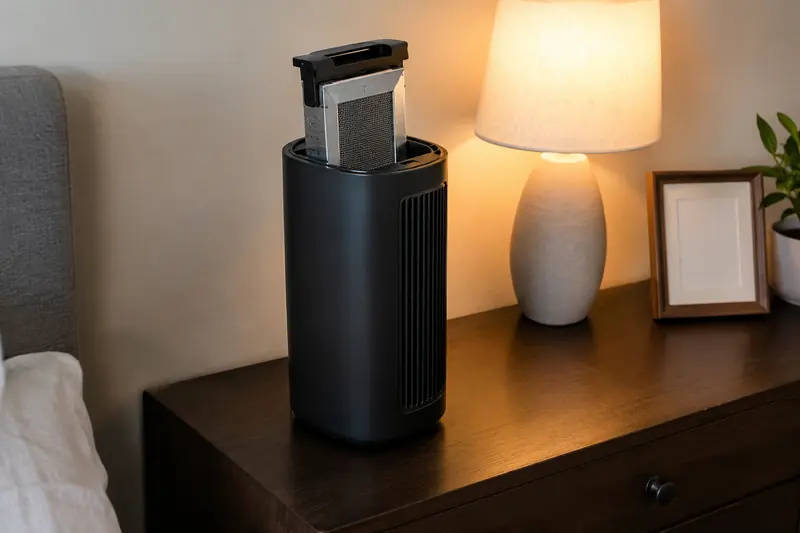
AI-made picture, not a photo of a real house Is an ozone air purifier safe to use at home?
No: an ozone air purifier releases a lung irritant on purpose. Federal approvals for occupied spaces: none, according to EPA. Ozone's loose third oxygen atom is what reacts with other substances, and that reactivity is also what harms the lungs. EPA lists chest pain, coughing, shortness of breath and throat irritation at relatively low amounts, and says ozone can worsen asthma.
Turn over for the detail
The case for using it anyway is weak. EPA's review found that at concentrations that do not exceed public health standards, ozone has little potential to remove indoor air contaminants. It does not remove dust or pollen, and it is not effective against carbon monoxide or formaldehyde. Where it does react with indoor chemicals, it can create aldehydes and other irritating by-products.
Following the label doesn't solve this. EPA reports that concentrations "considerably higher" than health standards are possible even when a user follows the maker's instructions. In one study, a large generator set on high in a 350 sq ft room reached 0.50–0.80 ppm, 5 to 10 times public health limits.
Source the documents listed on this stack's sources card
Next What does California's ozone limit mean?↓What does California's ozone limit mean?
It means any electronic air cleaner sold in California must be tested and shown to emit no more than 0.050 ppm (50 ppb) of ozone. From 2010 on, every portable indoor air cleaning device sold in the state has needed certification from the California Air Resources Board, and electronic in-duct cleaners joined the rule in October 2020. All certified units are also tested for electrical safety.
Air cleaner types and the ozone question Type How it works What EPA or CARB says about ozone and by-products Ozone generator Makes ozone on purpose Not approved by any federal agency for occupied spaces Ionizer Charges particles so they stick to surfaces or settle May emit ozone; CARB "Electronic" group Electrostatic precipitator Collects charged particles on metal plates May emit ozone; CARB "Electronic" group Photocatalytic oxidation (PCO) UV light on a catalyst Shown to make formaldehyde, acetaldehyde, nitrogen dioxide and CO Plasma Electrical discharge in the airstream Can form particles, ozone, CO and formaldehyde Mechanical filter (pleated or HEPA) Traps particles in fibers Makes no ozone or ions; CARB "Mechanical" group Turn over for the detail
CARB sorts certified devices into two groups. "Mechanical" units use only physical filtration, such as pleated or HEPA-style filters, and make no ozone or ions. "Electronic" units, a group that includes ionizers, electrostatic precipitators, photocatalytic oxidation (PCO), hydroxyl generators and devices with UV lamps, may make some ozone but passed the 0.050 ppm test. For context, EPA notes the FDA caps ozone output from indoor medical devices at 0.05 ppm, the same level.
Read the certification for what it is. CARB states plainly that its certification does not reflect a cleaner's effectiveness or "health safety." The list answers one question well: does this device keep ozone under the limit? Wherever you live, check the California Air Resources Board's certified list before buying any electronic cleaner.
What about ionizers and other electronic cleaners?
Ionizers can make some ozone and catch particles less well than filters, so treat them as a weaker, riskier choice. EPA describes an ionizer as releasing charged ions that attach to particles, which then cling to walls and furniture or settle. In experiments EPA cites, ionizers removed dust, smoke, pollen and spores less effectively than high-efficiency filters or electrostatic precipitators.
Turn over for the detail
The by-product list is longer than most boxes admit. EPA's technical summary on residential air cleaners reports that PCO cleaners have been shown to generate formaldehyde, acetaldehyde, nitrogen dioxide and carbon monoxide, that plasma units can form particles, ozone, carbon monoxide and formaldehyde, and that electrostatic precipitators, ionizers and uncoated UV lamps can emit high levels of ozone. EPA's home air cleaner guide adds that research has not shown plasma, PCO or UV units remove gases effectively in portable home cleaners.
In-duct electronic cleaners mean work on the furnace or air handler, so leave them to an HVAC contractor and ask for the exact model's CARB certification first. If you're unsure, call a licensed pro.
How can you spot a risky claim?
Look for words that make ozone sound healthy, hints of government approval, and promises about germs or odors. EPA calls out terms like "energized oxygen" and "pure air" as misleading, because ozone is a toxic gas with very different properties from the oxygen we breathe. If a seller says the device is government-approved for occupied rooms, EPA says the opposite is true.
Turn over for the detail
An EPA establishment number on the box is another trap. EPA says it only identifies the facility that made the product and does not imply EPA endorsement, safety or effectiveness. Be just as skeptical of claims about destroying viruses, bacteria or mold: EPA says ozone would need to be 5 to 10 times higher than health standards to decontaminate the air.
Regulators have acted on these claims before. In 1995 the FTC settled with two marketers of home ozone generators over unsubstantiated air-cleaning claims, and in 1998 it sought civil penalties from one of them. A quick checklist before you buy:
- Does the box promise "energized oxygen" or "pure air" from ozone? Walk away.
- Is the model on the CARB certified list, and is it in the "Mechanical" group?
- Does it show a smoke CADR on an AHAM seal, so you can size it?
What should you buy instead?
Choose a filter-based portable cleaner sized by its CADR, a better central filter, and fix the sources first. EPA says filtration does not replace controlling pollutants and ventilating, so run the bath fan and kitchen hood and keep indoor humidity in range.
For particles, pick a mechanical cleaner with a smoke CADR big enough for the room; the air purifier CADR page walks through the 2/3 rule. For the whole house, a higher MERV filter in the central system helps while the blower runs. For odors and chemical vapors, EPA recommends a cleaner with plenty of activated carbon, not ozone. EPA adds that CARB and AHAM both list cleaners tested to emit little or no ozone.
Source the documents listed on this stack's sources card
Next Ozone numbers from EPA and CARB↓Ozone numbers from EPA and CARB
Chart drawn by Air in the House from figures cited in this stack.
Quick cards
Short questions people ask next, one answer each.
Do ionizers leave dust on walls?
They can. EPA says ionizers make particles cling to nearby surfaces such as walls and furniture, so some of the dirt lands there rather than in a filter.
Is the CARB certified list useful outside California?
Yes. A model's ozone test result holds wherever it is sold, so the list is a quick check on any electronic cleaner in any state.
Does an ionizer give off ozone?
It can. EPA lists ionizers among the cleaners that may emit ozone, and CARB puts them in its "Electronic" group, which must test at or under 0.050 ppm to be certified.
Is a UV light in the ductwork an ozone source?
Some are. EPA says UV lamps without adequate coatings may emit ozone, and CARB has covered electronic in-duct cleaners since October 2020. Ask the installer for the certified model number.
Can ozone get rid of smoke or pet odor in a house?
EPA says ozone at levels within health standards is not effective at removing many odor-causing chemicals, and some odors may only be masked. Removing the source and using a carbon filter is the better route.
Does CARB certification mean a cleaner works well?
No. CARB says certification does not reflect effectiveness or health safety; it confirms electrical safety and, for electronic units, ozone under the limit. Use the CADR to judge cleaning power.
Where these cards come from
This stack relies on EPA's ozone generator review, EPA's home air cleaner guide and its technical summary of residential air cleaners, the California Air Resources Board's certification page, and FTC press releases from 1995 and 1998, read in October 2026. It names no products or companies and does not cover commercial uses of ozone.
- EPA EPA
- California Air Resources Board certification from the California Air Resources Board
- EPA technical summary on residential air cleaners
- EPA home air cleaner guide
- FTC FTC settled with two marketers of home ozone generators
Cards are written by the Air in the House editors from the documents above and dated when they were last checked. How stacks are made