Filters and cleaners · stack · 7 quick cards
MERV Rating: Choosing a Furnace Filter
7 cards · By the Air in the House editors, from EPA, ENERGY STAR · how stacks are made · Updated · this stack links to businesses tied to our owners, and each link says how
Which MERV rating does your system need?
A MERV rating tells you how well a furnace filter traps particles from 0.3 to 10 microns; EPA suggests MERV 13 or the highest rating your system's fan and filter slot can handle.
- MERV runs from 1 to 16 under ASHRAE Standard 52.2; EPA's MERV table covers particles from 0.3 to 10 µm.
- A MERV 13 filter must catch at least 50% of the smallest particles tested (0.3–1 µm); MERV 8 has no requirement in that range and MERV 11 needs 20%.
- EPA suggests at least MERV 13, or as high a rating as the system fan and filter slot can take.
- EPA's Guide to Air Cleaners in the Home says most furnaces can take a MERV 13 if it is replaced frequently.
- ENERGY STAR: check the filter monthly and change it at least every 3 months.
- A central system filters only while its blower runs, which EPA says is usually under 25% of the time in heating and cooling seasons.
AI-made picture, not a photo of a real house What does a MERV rating mean?
A MERV rating is a number that reports how well an air filter captures particles between 0.3 and 10 microns, the range that holds dust, pollen, mold spores and smoke. MERV stands for Minimum Efficiency Reporting Value. The test method comes from ASHRAE, and MERV runs from 1 to 16 under ASHRAE Standard 52.2. The higher the number, the larger the share of small particles the filter holds on each pass, as EPA's explainer on MERV puts it.
Turn over for the detail
Two other labels show up on filter boxes: FPR and MPR. EPA notes that MERV is based on a national consensus standard, while the FPR and MPR methods are proprietary. That makes MERV the only number you can compare from one maker to the next, so look for it on the frame or the package before anything else.
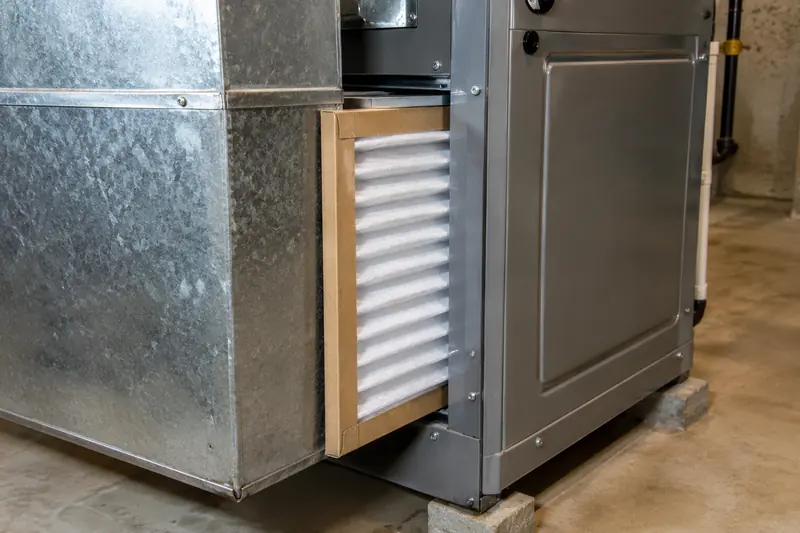
Every forced-air system has a filter slot, at the furnace or behind a return grille, and air passes through it only while the blower runs. That run-time catch comes up again below.
What do MERV 8, 11 and 13 catch?
They differ most in the smallest size band: a MERV 8 has no requirement for particles from 0.3 to 1 µm, a MERV 11 must catch at least 20% of them, and a MERV 13 at least 50%. Particles that small are the ones EPA calls the fine particles of greatest health concern (PM2.5), the kind that make up smoke. For bigger dust and pollen, all three grades do reasonably well.
What EPA's MERV table requires, by particle size Filter 0.3–1 µm (smoke-sized) 1–3 µm 3–10 µm (pollen-sized) MERV 8 No requirement 20% or more 70% or more MERV 11 20% or more 65% or more 85% or more MERV 13 50% or more 85% or more 90% or more MERV 16 95% or more 95% or more 95% or more HEPA (not a MERV grade) 99.97% at 0.3 µm - - Turn over for the detail
Read the table from left to right. A 50% capture rate for the smallest band is the line EPA uses when it says filters rated MERV 13 and above "are required to demonstrate at least 50% removal efficiency for the smallest particles tested." So MERV 13 is EPA's suggested minimum, and 50% is the share of the smallest particles a MERV 13 must catch.
MERV 8 still stops 70% or more of pollen-sized particles, so it handles everyday dust and pollen. To see the range, Plumbing Supply and More has an air filter category (Plumbing Supply and More, owned by the people behind Air in the House) with panel and pleated furnace filters from MERV 4 up to MERV 13 in many sizes. Before buying any size, read the nominal dimensions printed on your old filter's frame.
Source the documents listed on this stack's sources card
Next Can your system handle MERV 13?↓Can your system handle MERV 13?
Usually yes: EPA says most furnaces and HVAC systems can accommodate a MERV 13 filter without equipment problems, provided the filter is replaced frequently. The thing to watch is airflow. EPA's technical summary on residential air cleaners says airflow resistance generally, though not always, rises with MERV for a given thickness, and it climbs further as the filter loads up with dust.
Turn over for the detail
EPA suggests at least MERV 13, or the highest rating your system's fan and filter slot can handle. Ask an HVAC technician if you're unsure; a thicker (4–5 in.) media filter usually lowers airflow resistance. EPA also points out that systems are rarely labeled with any filter recommendation, and that a technician can modify a system to take a higher-efficiency filter. That is not the same as the highest MERV on the shelf: a filter the blower can't pull air through helps nobody.
Useful questions for the technician: Which MERV can this blower handle in this slot? Would a deeper filter cabinet allow MERV 13? How often will that filter need changing? Changing a filter is homeowner work; changing ductwork or the blower is not. If you're unsure, call a licensed pro.
Is a thick media filter better than a 1-inch filter?
At the same MERV, a deeper filter usually is, because more pleated media spreads the airflow and lowers resistance. EPA's technical summary says flat or panel filters are typically 1–2 inches thick with low airflow resistance, while deeper pleated, extended-surface filters may be 4–12 inches. The EPA home guide says household filters commonly come in thicknesses of 1 to 5 inches.
Turn over for the detail
A 4–5 in. media filter depth only works in a cabinet built for it; you can't squeeze one into a 1-inch slot. Whatever the depth, EPA's rule is the same: the filter must fit snugly, with no gap for air to leak around it, and you shouldn't have to bend or crush it to fit. Air that slips past the edges isn't filtered at all.
Washable mesh filters like the one above are another option. Whatever the type, look for a MERV number on the frame or packaging; if there isn't one, you have nothing to compare it against.
How often should you change the filter?
Check the filter monthly and change it when it looks dirty, at least every 3 months (ENERGY STAR), more often during smoke events or heavy use. Three months is the longest gap between changes, not a target. EPA adds that makers typically recommend replacement every 60 to 90 days, and that a filter that looks heavily soiled when you pull it is a sign to change it sooner.
Turn over for the detail
Smoke speeds everything up. During wildfire smoke events, EPA says filters may need changing every few weeks or even days; the wildfire smoke page covers that season in detail. Write the install date on the frame with a marker so the next check is easy.
Remember the run-time catch. EPA notes a furnace or AC usually runs less than 25% of the time during heating and cooling seasons, and filters only while it runs. Setting the fan to run longer filters more air, but EPA warns it adds electricity cost and can make humidity control less reliable in cooling season. For a single room, a portable air cleaner sized by CADR often does more.
MERV numbers at a glance
- 1–16MERV scale in EPA's tableEPA
- 50%minimum MERV 13 capture of 0.3–1 µm particlesEPA
- 3 monthslongest gap between filter changesENERGY STAR
- 60–90 daystypical maker replacement intervalEPA
- 25%share of the season a central system often runsEPA
Chart drawn by Air in the House from figures cited in this stack. Source EPA · ENERGY STAR
Next Quick cards↓
Quick cards
Short questions people ask next, one answer each.
Is MERV 13 the same as a HEPA filter?
No. HEPA means at least 99.97% capture at 0.3 µm, and EPA lists it separately because it is not part of the MERV scale. HEPA filters are common in portable air cleaners rather than in furnace slots.
Can an FPR or MPR number be converted to MERV?
EPA gives no conversion. It describes FPR and MPR as proprietary methods and MERV as the national consensus standard, so compare filters by MERV whenever the package shows it.
Which way should the arrow on a furnace filter point?
The arrow shows the direction of airflow, so it should point away from the return duct and toward the blower. A filter put in backward still fits but may not perform as rated.
Does a window air conditioner's filter clean the room air?
Not much. EPA says most window and wall-mounted ductless units are built for temperature control, with limited filtration meant to keep the unit itself clean rather than remove fine particles.
Should the furnace fan run on "On" instead of "Auto"?
It filters more air on "On," which EPA recommends during smoke events. The trade-offs, per EPA, are higher electricity use and less reliable humidity control in cooling season.
Will a higher MERV filter stop dust from settling on furniture?
It can trap more of the dust that passes through it, but only while the blower runs. Dust that never reaches a return grille stays in the room, so cleaning and source control still matter.
Is there a MERV rating above 16?
Not in EPA's table, which stops at MERV 16. Some older documents show a longer scale, but this site uses the 1–16 range EPA publishes.
Parts and pages this stack names
About these links: the people behind Air in the House also own Plumbing Supply and More, SoftPro Water Systems and Quality Water Treatment, and work with Central Plumbing & HVAC. Nobody pays to be mentioned here. Our notes on these cards are ours; what a linked page says is that business's own claim. Who owns this site
HVAC air filters, MERV 4 to MERV 13, many sizes
Plumbing Supply and More · owned by the people behind Air in the House
Filters you can change yourself: match the size printed on the old filter's frame and its airflow arrow. Ask an HVAC technician before moving to a much higher MERV.
Open Plumbing Supply and MoreFurnace filters and in-duct air-quality equipment
Plumbing Supply and More · owned by the people behind Air in the House
The store's wider indoor-air section: furnace filters plus in-duct parts such as UV lights and humidifiers. Filters you can swap yourself; in-duct equipment is installer work, and EPA cautions that some UV lamps can make ozone.
Open Plumbing Supply and More
Where these cards come from
This stack is based on EPA's MERV explainer, EPA's Guide to Air Cleaners in the Home, EPA's technical summary of residential air cleaners and ENERGY STAR's heating and cooling advice, each read in October 2026. It leaves out brand picks and price comparisons, and it does not guess at the pressure limits of any particular furnace, which only a technician can check.
- EPA EPA's MERV table
- EPA EPA's Guide to Air Cleaners in the Home
- EPA technical summary on residential air cleaners
- ENERGY STAR ENERGY STAR
Cards are written by the Air in the House editors from the documents above and dated when they were last checked. How stacks are made