Bathroom · stack · 7 quick cards
How Long to Run a Bathroom Fan
7 cards · By the Air in the House editors, from Home Ventilating Institute, EPA, U.S. Department of Energy, NDSU Extension and other documents · how stacks are made · Updated
How long should the bathroom fan run?
How long to run a bathroom fan? Through the whole shower and about 20 minutes afterward, the Home Ventilating Institute's guidance, with a timer or humidity control doing the remembering.
- The Home Ventilating Institute says to leave the fan on for 20 minutes after using the bathroom, and calls a timer a good solution.
- The DOE Building America guide recommends delay-off switches of at least 10 minutes, a floor rather than a target.
- EPA's mold guide says to run the bathroom fan or open the window when showering.
- EPA's indoor humidity target is 30–50%, and never above 60% for long.
- A bath fan can also run nonstop: the IRC accepts 20 cfm continuous in place of 50 cfm intermittent.
- Timers and humidity-sensing switches go in on a licensed electrician's visit; your part is picking the control and setting it.
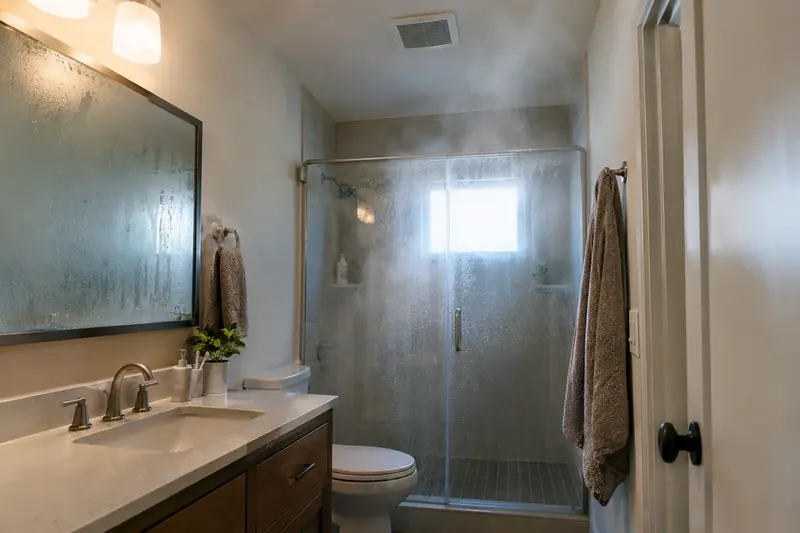
AI-made picture, not a photo of a real house How long should you run a bathroom fan after a shower?
Switch the fan on when the shower starts and leave it running for about 20 minutes after you step out, which is what the Home Ventilating Institute's bathroom page recommends. A timer or a humidity-sensing control can handle the off switch so nobody has to come back for it. Twenty minutes is HVI's figure; no ENERGY STAR or DOE page read for this site gives a post-shower target, and DOE's ventilation guide sets only a 10-minute minimum for delay-off switches.
Turn over for the detail
The DOE's Building America ventilation guide comes at it from the switch side: delay-off controls should hold the fan on for at least 10 minutes. Read that as the shortest sensible setting. If the mirror is still fogged when the fan stops, the run was too short.
A fan that is undersized or badly ducted needs longer than 20 minutes, because it moves less air than its label says. Sizing is covered on the bathroom exhaust fan size page.
Why does run time matter so much?
Run time matters because a shower leaves the room full of water vapor, and the fan only removes it while the motor turns. Switch it off with the walls still damp and the moisture settles into paint, grout, towels and the cold corners of the ceiling. EPA ties mold directly to moisture and asks homeowners to dry wet areas and items within 24–48 hours.
Bath fan controls compared Control How it decides when to stop Good for Watch out for Plain on/off switch Whoever remembers Guest baths used rarely Fans left off too early or on all day Countdown timer A dial or button set to a fixed time Households that want a set 20 minutes Too short a setting on a weak fan Delay-off switch Keeps running a preset time after the light goes off Hands-off use; DOE suggests at least 10 minutes Needs a sensible delay, not the minimum Humidity-sensing control Runs until the room's humidity drops back Long or back-to-back showers Setting needs adjusting per its manual Continuous low speed with boost Never stops; speeds up on demand Tight houses that need steady ventilation Must be quiet enough to leave on Turn over for the detail
Humidity is the number to watch. EPA's mold guide suggests keeping indoor relative humidity in the 30–50% band it calls ideal, and never letting it stay above 60%. In cold weather, aim nearer 30–40% if windows sweat; the winter humidity page explains why.
Bathrooms are only one source. By NDSU Extension's count, simply breathing puts roughly 3 pints of moisture per person into the air daily, before anyone showers, cooks or does laundry. A fan that runs long enough is one of the cheapest ways to keep the whole-house number down, and EPA notes that condensation on windows or walls can be a sign of high humidity.
Which timer or sensor switch fits?
The right control is the one that makes the fan run long enough without anyone thinking about it. For most households that means a countdown timer set to 20 minutes or more, or a humidity-sensing control that keeps the fan going until the room dries out. HVI's own page names a timer as a good solution.
A humidity-sensing control suits homes with long showers, several people bathing back to back, or children who never touch the switch. Set its trigger point by its manual: too high and it barely runs, too low and it never stops in humid summer weather. The DOE guide adds that a timer-controlled fan should still have a manual "On" switch in the bathroom.
Turn over for the detail
Replacing a wall switch with a timer, or adding a sensor, means opening an electrical box, and that is a licensed electrician's job. Your part is choosing the control and setting it per its manual. If you're unsure, call a licensed pro.
Source the documents listed on this stack's sources card
Next Should the fan run all the time?↓Should the fan run all the time?
A fan can run all the time if it is built for it and the airflow is right. The International Residential Code lets a bath fan run continuously at 20 cfm instead of the usual 50 cfm intermittent rate, per IRC Table M1505.5, and HVI also accepts continuous low-rate ventilation as an alternative.
In tighter houses, a quiet bath fan running nonstop often doubles as the home's whole-house fresh-air system, which the IRC and ASHRAE 62.2 size by floor area and bedrooms. The ASHRAE 62.2 page shows that arithmetic. Any fan meant to run around the clock should be quiet; ENERGY STAR caps bath fans up to 200 cfm at 2.0 sones.
Turn over for the detail
An always-on fan is still an exhaust fan, and it pulls replacement air in through gaps in the house. In homes with older gas, oil or wood appliances, too much exhaust can pull flue gases back down a chimney, so ask a qualified pro for a combustion safety test before adding big new exhaust. The exhaust, supply or balanced page explains the trade-offs.
How do you know the fan is doing its job?
The quickest proof is the room itself: if the mirror clears and the walls are dry within the run time, the fan is keeping up. If a haze hangs on the mirror long after, paint peels over the shower or the corners grow spots, it is not. A cheap hygrometer on a shelf shows the humidity climbing during the shower and falling after.
Turn over for the detail
A tissue test checks airflow at the grille in seconds, and the venting page walks through it along with how to check where the duct ends. To clean a dusty grille, switch the fan's breaker off first. If you hear the fan but feel no pull, the duct may be crushed, disconnected or blocked, and that calls for an HVAC contractor or electrician.
Source the documents listed on this stack's sources card
Next Run time in numbers↓Run time in numbers
- 20 minHVI's run time after a bathroom is usedHome Ventilating Institute
- 10 minDOE's minimum delay-off settingDOE Building America
- 20 cfmCode rate for an always-on bath fanIRC Table M1505.5
- 30–50%Humidity band EPA calls ideal indoorsEPA
Chart drawn by Air in the House from figures cited in this stack.
Quick cards
Short questions people ask next, one answer each.
Is 10 minutes enough after a shower?
Ten minutes is the DOE guide's floor for delay-off switches, not a target. HVI's figure is 20 minutes, and a weak fan or a long hot shower may need longer.
Should the fan run during a bath as well as a shower?
Yes. EPA's mold advice names showering, but a hot bath fills the room with vapor too. Leave the fan running afterward just as you would after a shower.
Does an open window replace the fan?
EPA accepts either during a shower, but a window only helps when outdoor air is drier and moving. In cold weather an open window chills the room while doing little, and many baths have no window at all.
Can a humidity-sensing fan run too much?
It can in humid summer weather if its trigger is set below the outdoor humidity, because the room never dries below that point. Raise the setting a little per the control's manual.
Is it bad to leave a bath fan on all night?
A fan rated for continuous use can run all night; the IRC even allows a 20 cfm continuous rate. Check the fan's manual to confirm it is meant for continuous duty.
Why does the mirror stay foggy even with the fan on?
Either the fan moves too little air or it stopped too soon. Check its size against HVI's 1 cfm per square foot and check the duct for crushed or long runs.
Does running the fan longer waste a lot of heat?
Every exhaust fan pulls out some heated or cooled air, which is the price of removing the moisture. ENERGY STAR sets minimum cfm per watt, so a certified fan uses less electricity for the same airflow.
Where these cards come from
Sources for this stack: HVI's bathroom ventilation guidance, the DOE Building America ventilation guide, the 2024 International Residential Code, EPA's mold guide, ENERGY STAR's fan criteria and NDSU Extension, all read in October 2026. No switch or fan brands are recommended and no wiring steps appear, because installing controls is a licensed electrician's work.
- Home Ventilating Institute Home Ventilating Institute
- EPA EPA's mold guide
- U.S. Department of Energy Building America ventilation guide
- NDSU Extension NDSU Extension's count
- International Residential Code IRC Table M1505.5
- ENERGY STAR ENERGY STAR caps bath fans
Cards are written by the Air in the House editors from the documents above and dated when they were last checked. How stacks are made