Bathroom · stack · 6 quick cards
Bathroom Exhaust Fan Size, Worked Out
8 cards · By the Air in the House editors, from Home Ventilating Institute, International Residential Code, U.S. Department of Energy, ENERGY STAR · how stacks are made · Updated
How big a bathroom fan do you need?
Bathroom exhaust fan size starts at 1 cfm per square foot of floor for baths up to 100 sq ft, but never below the 50 cfm code minimum, rated at 0.25 inch static pressure.
- The Home Ventilating Institute sizes baths up to 100 sq ft at 1 cfm per square foot, about 8 air changes per hour.
- Baths over 100 sq ft are sized by fixture: 50 cfm each for a toilet, shower and tub, 100 cfm for a jetted tub (HVI).
- The IRC (Table M1505.5) sets 50 cfm for a fan that is switched on and off, or 20 cfm for one that runs all the time.
- The code wants that airflow at 0.25 inch of static pressure; a fan rated 50 cfm at 0.1 inch may move only 23–31 cfm once ducted (DOE Building America).
- ENERGY STAR caps bath fans of 10–200 cfm at 2.0 sones; one sone is roughly a quiet refrigerator (HVI).
- Buy at least 50 cfm, and size up for long duct runs, elbows or a separate toilet room.
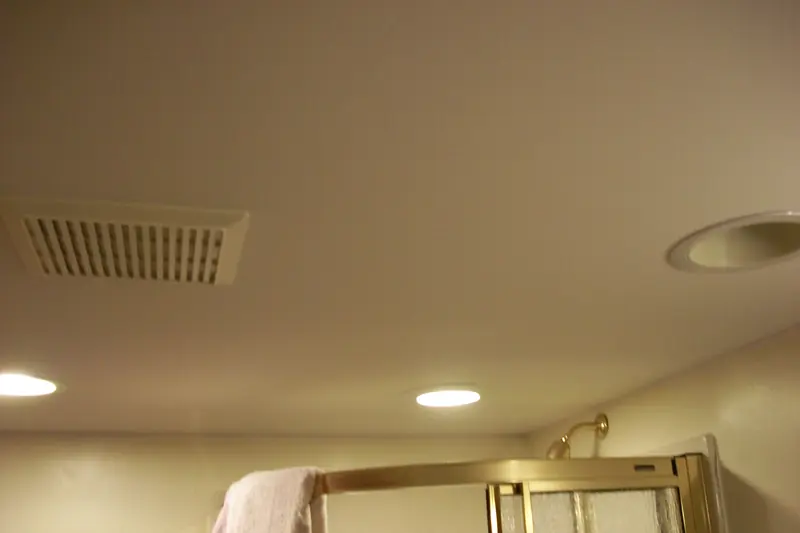
What size bathroom exhaust fan do you need?
For a typical bathroom of 100 sq ft or less, you need a fan rated at 1 cfm (cubic foot per minute) for every square foot of floor, and never less than 50 cfm. The per-foot rule comes from the Home Ventilating Institute's bathroom guidance, which says it works out to about 8 air changes per hour. HVI's own example is an 8 by 5 ft bath: 40 sq ft, so a 40 cfm minimum.
Bathroom exhaust fan size for common rooms Bathroom Floor area HVI figure Fan to buy (at 0.25 in.) Powder room, 5 x 6 ft 30 sq ft 30 cfm 50 cfm (code minimum) Hall bath, 8 x 5 ft 40 sq ft 40 cfm 50 cfm (code minimum) Family bath, 9 x 10 ft 90 sq ft 90 cfm 90 cfm or more Main suite, 20 x 12 ft, tub + shower + enclosed toilet 240 sq ft 150 cfm by fixtures 150 cfm total, split between fans Turn over for the detail
Building codes then set a floor under that. The International Residential Code and ASHRAE 62.2 both ask for 50 cfm from an intermittent bath fan, so the 40 sq ft bath still gets a 50 cfm fan. Measure length times width, compare it with 50, and take the larger number.
That number is a minimum. Long duct runs, elbows or an enclosed toilet push it up. Once the size is settled, the next questions are how long to run the fan and where its duct must end.
What about big or odd-shaped bathrooms?
Above 100 sq ft, HVI stops counting floor area and adds up the fixtures instead: 50 cfm for a toilet, 50 for a shower, 50 for a bathtub and 100 for a jetted tub. Its worked example is a 20 by 12 ft suite with a tub, a shower and an enclosed toilet, which totals 150 cfm. HVI says that can be three 50 cfm fans, one over each fixture, or one 150 cfm fan.
Turn over for the detail
Placement matters as much as the total. HVI puts exhaust points over or near the shower or tub and inside an enclosed toilet room, because steam and odor are easiest to catch close to where they start. It also says bathroom doors should be undercut so replacement air can get in; a fan can't pull air out of a sealed box.
For an L-shaped or angled room, split the floor into rectangles and add their areas. Under 100 sq ft, use 1 cfm per square foot; over it, count fixtures.
Source the documents listed on this stack's sources card
Next What is the code minimum?↓What is the code minimum?
The code minimum for a bathroom or toilet room is 50 cfm intermittent or 20 cfm continuous, from IRC Table M1505.5. Intermittent means the fan runs when someone switches it on; continuous means a quiet fan that never stops. ASHRAE 62.2, the national residential ventilation standard, uses the same two numbers.
The same chapter adds two conditions people often miss. The fan's listed airflow has to meet the table at 0.25 inch of water column, and the fan must be listed under HVI 916 or AMCA 210, which is why a bath fan's box or spec sheet shows a certified airflow rating. Your local code may differ, so check with your building department before you buy for a remodel.
Why does the rated CFM drop once installed?
A fan's airflow falls as resistance rises, and every foot of duct, elbow and outdoor cap adds resistance, measured as static pressure in inches of water. Many fans are advertised at 0.1 inch, a light load that real installations rarely match. The DOE Building America ventilation guide says a typical fan rated 50 cfm at 0.1 inch moves closer to 23–31 cfm at 0.25 inch.
Turn over for the detail
That gap is why the code asks for the 0.25 inch rating. When you compare fans, look for the airflow figure at 0.25 inch and ignore the bigger number on the front of the box. The duct itself matters too: in the code's duct-length table, a 4-inch flexible duct on a 50 cfm fan may run 56 feet, while a smooth 4-inch duct may run 114 feet, and every elbow subtracts 15 feet. The venting page covers the run in detail.
How quiet should the fan be?
Aim for 2.0 sones or less on a fan up to 200 cfm, which is the ENERGY STAR ceiling. A sone is a loudness unit on a straight-line scale, so a 2-sone fan sounds twice as loud as a 1-sone fan; HVI describes one sone as the sound of a quiet refrigerator in a quiet kitchen.
Noise matters because a loud fan gets switched off early, and a bath fan only clears moisture while it runs. Between two fans with equal airflow at 0.25 inch, pick the quieter one.
What does ENERGY STAR add?
ENERGY STAR adds limits on noise, efficiency and installed airflow on top of the code. Under its ventilation fan criteria, bath and utility fans of 10–200 cfm may make no more than 2.0 sones, and fans of 201–500 cfm no more than 3.0 sones. Minimum efficacy is 2.8 cfm per watt for 10–89 cfm fans, 3.5 for 90–200 cfm and 4.0 for 201–500 cfm.
Video from the Home Ventilating Institute HVI channel on YouTube: HVI Certified Ratings for Fans Explained Part 1: CFM (Airflow). That channel has no tie to Air in the House; nothing loads from YouTube except the still picture until you press play. Turn over for the detail
The criteria also require a certified bath fan to keep at least 70% of its 0.1 inch airflow when tested at 0.25 inch, so the label says something about real performance. ENERGY STAR adds that certified fans with lighting use 70% less energy on average than standard models. Wiring a new or larger fan, or adding a fan with a light, is a licensed electrician's job. If you're unsure, call a licensed pro.
Bath fan sizing in numbers
- 1 cfm/sq ftHVI rate for baths up to 100 sq ftHome Ventilating Institute
- 50 cfmCode minimum for an intermittent bath fanIRC Table M1505.5
- 23–31 cfmWhat a fan rated 50 cfm at 0.1 in. may move at 0.25 in.DOE Building America
- 2.0 sonesENERGY STAR maximum for 10–200 cfm bath fansENERGY STAR
Chart drawn by Air in the House from figures cited in this stack.
Quick cards
Short questions people ask next, one answer each.
Is a bigger bath fan always better?
Not always. An oversized fan can be louder and may be choked by a small duct. Size by HVI's rule or the fixture count, then add capacity only for long runs or extra fixtures.
Do high ceilings change the fan size?
HVI's 1 cfm per square foot is a floor-area rule meant to give about 8 air changes per hour in an ordinary bath. A room with a tall or vaulted ceiling holds more air, so many people choose a size up; the code minimum of 50 cfm does not change.
What does HVI-certified mean on a fan box?
It means the airflow and sound figures were tested under HVI's certification program, one of the two listing routes the IRC accepts. It is the best way to compare fans from different makers on equal terms.
Does a fan with a light still need to meet the airflow numbers?
Yes. The light is extra; the fan must still meet 50 cfm intermittent at 0.25 inch.
Should a toilet room inside the bath get its own fan?
HVI suggests an exhaust point in an enclosed toilet room, and its 20 by 12 ft example counts 50 cfm for the toilet alone. A door between the toilet and the main fan blocks most of the airflow, so a small separate fan is common.
What is a good sone rating for a quiet bath?
Under 2.0 sones meets ENERGY STAR for fans up to 200 cfm, and fans near 1 sone are about as loud as a quiet refrigerator. Compare sones at the same airflow, since a fan gets louder as it works harder.
Where these cards come from
This stack draws on the Home Ventilating Institute's bathroom ventilation and sone publications, the 2024 International Residential Code (Chapter 15), the DOE Building America ventilation guide and the ENERGY STAR ventilation fan criteria, all read in October 2026. It names no fan brands or models and gives no prices; every room size in the table is plain arithmetic on HVI's and the code's rules.
- Home Ventilating Institute Home Ventilating Institute
- International Residential Code IRC Table M1505.5
- U.S. Department of Energy DOE Building America ventilation guide
- Home Ventilating Institute HVI describes one sone
- ENERGY STAR ventilation fan criteria
- ENERGY STAR certified fans with lighting
Cards are written by the Air in the House editors from the documents above and dated when they were last checked. How stacks are made